
Distillation Towers
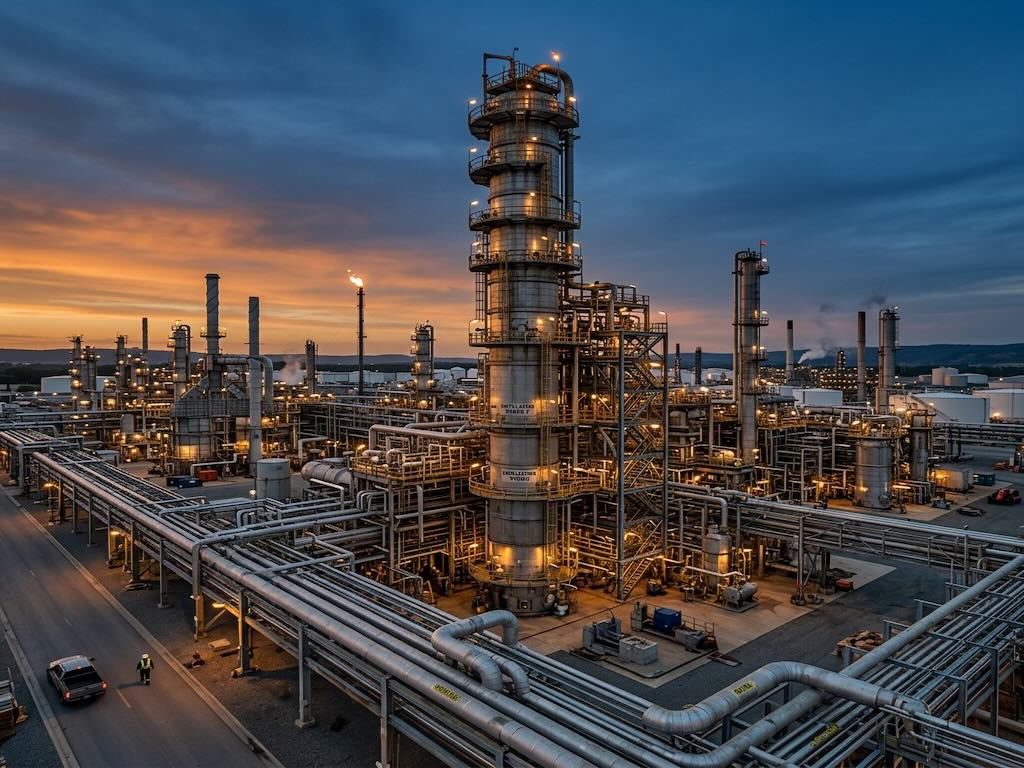
A distillation tower—frequently referred to as a distillation column or fractionating column—is one of the most fundamental operational structures utilized in industrial chemistry, crude oil refineries, and petrochemical processing. Leveraging specialized design and consultancy, its singular objective—the physical separation of a liquid mixture into its individual fractions (or cuts) by exploiting the distinctly different boiling points of the compounds contained within—can be achieved safely and optimally.
The Principles of the Distillation Process

Distillation relies on the principles of thermal volatility and vapor-liquid equilibrium (VLE). When a complex mixture, like crude oil, is heated in an external furnace, it partially vaporizes. This hot gas-liquid mixture is pumped into the bottom of the distillation column.
As the vapor rises upward through the tall column, the temperature systematically decreases. Compounds with the highest boiling points (heavy oils, asphalt) immediately condense at the extremely hot bottom of the tower. Compounds with lower boiling points (like naphtha or gasoline) continue rising as vapor until they hit their specific condensation temperature higher up in the cooler regions of the tower, where they accumulate and are drawn off externally.
Key Internal Components of a Distillation Column
To maximize the separation purity, the upward-flowing hot vapor must intimately contact the downward-flowing cooled liquid (reflux) inside the column. This contact is achieved using highly specialized static equipment internals.
- Distillation Trays: The column is segmented by large horizontal metal plates called trays (such as bubble-cap, sieve, or valve trays). Vapor bubbles up through perforations in the tray, transferring heat and mass directly into the shallow pool of liquid resting on top of it.
- Structured and Random Packing: Alternatively, sections of the tower can be filled with geometric packing materials (like Pall rings or structured corrugated metal). Packing provides astronomical surface area and creates significantly lower pressure drops than trays, vastly improving operational efficiency in vacuum column physics.
Note on Reboilers and Condensers: Distillation towers do not operate effectively as isolated vessels. They rely heavily on supporting heat exchangers—specifically reboilers at the bottom to maintain high temperatures by constantly re-vaporizing liquid bottoms, and overhead condensers at the top to cool the rising vapor back into a recoverable liquid.
Fractional vs. Vacuum Distillation
| Process Type | Operational Principles | Common Output |
|---|---|---|
| Fractional Distillation (Atmospheric) | Functions at ambient atmospheric pressure to extract standard range products. | Gasoline, Kerosene, Diesel, Jet Fuel. |
| Vacuum Distillation | Functions under severe vacuum pressure below atmospheric levels, artificially dropping the boiling point of extremely heavy hydrocarbons to prevent thermal cracking. | Lubricating oils, heavy gas oils, raw asphalt. |
Engineering & Simulation Importance
Predicting the exact temperatures, reflux ratios, and theoretical tray spacing required to yield high-purity outputs is impossibly complex without robust mathematical modeling. Chemical engineers rely deeply heavily on process simulation platforms like ASPEN Plus and HYSYS to computationally construct the complex phase-equilibrium matrices required to design an industrial distillation column.