
All Types of Pressure Vessels based on ASME Section VIII
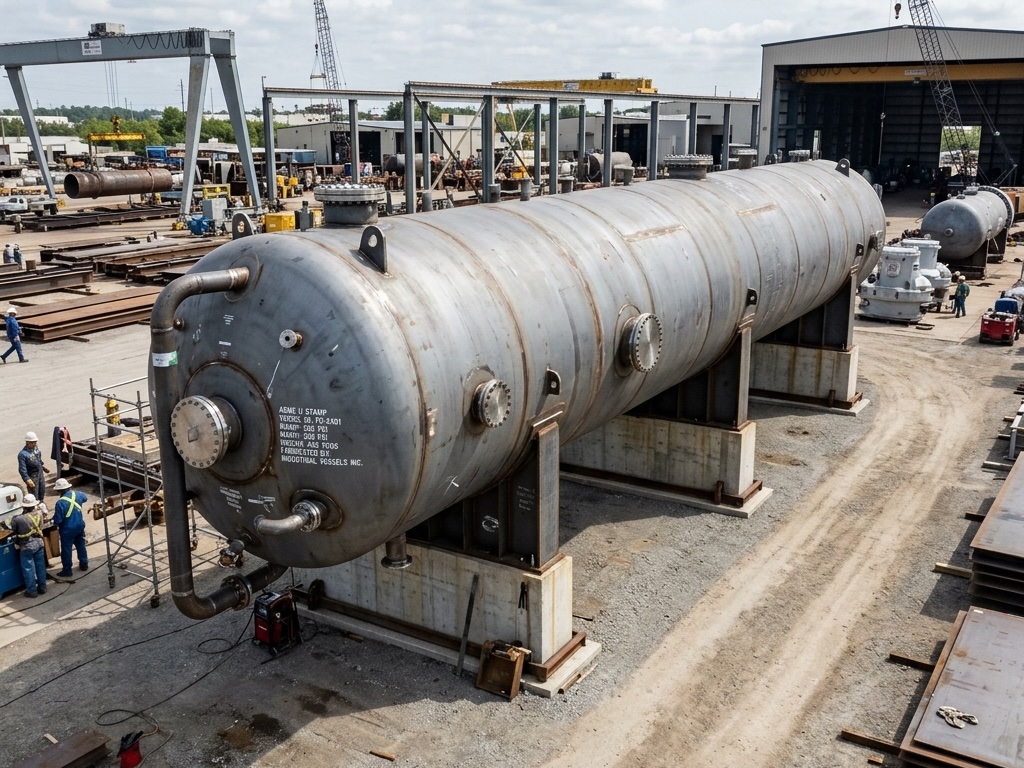
A pressure vessel is a heavy, rigidly enclosed container specifically engineered and constructed purposefully to hold gases, volatile vapors, or liquids safely at internal pressures drastically different from ambient outer atmospheric pressure. Guided by our meticulous design and consultancy solutions, we ensure that because containing compressed energy inherently turns the metal vessel into a potential high-yield bomb, their engineering, welding, and structural integrity are governed relentlessly worldwide by the ASME Boiler and Pressure Vessel Code (BPVC), specifically Section VIII.
What is the ASME Section VIII Code?
Originally published by the American Society of Mechanical Engineers to combat a horrific epidemic of catastrophic steam boiler explosions occurring in the early 1900s, the ASME BPVC has evolved into the absolute gold-standard legal framework governing pressure vessels globally. It legally mandates the exact mathematical formulas engineers must utilize to determine minimum wall thickness, exactly which steel alloys are permitted under certain horrific temperatures, and exactly how heavily welds must be X-ray inspected.
Did you know? While there are distinct differences globally—such as Europe heavily utilizing the EN 13445 standard—the ASME BPVC remains the most universally adopted mechanical code for demanding static equipment design across massive petrochemical infrastructure.
Division 1 vs. Division 2
Section VIII is broadly partitioned into deep, highly specialized divisions that heavily dictate how structural engineers utilize design software like PV Elite.
| Code Division | Design Methodology Principle | Industrial Implication |
|---|---|---|
| Division 1 | Design-By-Rule: Uses relatively simple, heavily conservative equations demanding very high built-in safety margins. | Extremely fast computational engineering, but heavily results in utilizing significantly thicker, vastly heavier steel plates. |
| Division 2 | Design-By-Analysis: Utilizes rigorous computational Finite Element Analysis (FEA) to meticulously calculate highly localized stress points accurately. | Permits significantly lower safety margins, allowing drastically thinner walls that heavily save multi-million dollar steel costs on colossal vessels. |
Common Variations of ASME Pressure Vessels
Pressure vessels are not merely empty tanks. They function actively as complex process nodes.
- Fractionating Columns: Insanely tall vertical structures integrating massive internal trays utilized strictly to boil and separate complex crude oil.
- Process Reactors: Utterly thick-walled vessels designed intentionally to withstand extremely hot, intensely violent chemical reactions (catalytic cracking, ammonia synthesis).
- Storage Bullets & Spheres: Specially welded, highly pressurized containers specifically holding wildly volatile liquefied gases (LPG, propane) safely in their liquid physical state.
- Shell and Tube Heat Exchangers: Where the external shell heavily acts as a complex pressure barrier while intense heat rapidly transfers from one incredibly violent fluid to another entirely.
Because they act as vital nodes, massive interconnected pipelines push rapidly against thick vessel shell nozzles. Advanced FEA local stress analysis is required intimately at the junction point to ensure the vessel will not completely fracture dynamically due to severe external thermal piping loads.
Non-Destructive Examination (NDE) and Quality Control
Due to the catastrophic consequences of a pressure vessel failure, ASME Section VIII rigidly mandates comprehensive Non-Destructive Examination (NDE) protocols throughout the manufacturing process. Engineers cannot simply assume a weld is structurally sound. Instead, they must physically prove its integrity using advanced diagnostic techniques.
Commonly employed methods include Radiographic Testing (RT) which utilizes powerful X-rays to detect hidden internal porosities, and Ultrasonic Testing (UT) which bounces high-frequency sound waves deep through the steel plate to identify microscopic laminations or cracking. For surface-level imperfections, technicians heavily utilize Magnetic Particle Inspection (MPI) and Dye Penetrant Testing (PT).
Post Weld Heat Treatment (PWHT)
When massive steel plates are welded together, the localized extreme heat of the welding arc creates severe internal residual stresses within the metal’s crystalline structure. Left untreated, these stresses can cause the vessel to fracture spontaneously under operating pressure or succumb rapidly to stress corrosion cracking (SCC) in harsh chemical environments.
To safely mitigate this, ASME codes frequently dictate mandatory Post Weld Heat Treatment (PWHT). The entire fabricated vessel is placed inside a colossal industrial furnace and slowly baked at specific metallurgical temperatures (often exceeding 600°C for carbon steel). This controlled thermal soaking gracefully relieves the trapped internal stress, permanently restoring the vessel’s ductility and mechanical toughness before it is officially stamped for field service.