Nozzle Pro: FEA-Based Nozzle Load Analysis for Pressure Vessels
The connection point between a pipe and a pressure vessel is one of the most mechanically complex — and most frequently under-designed — zones in industrial equipment. Nozzle Pro is the dedicated finite element analysis (FEA) tool that resolves this critical engineering challenge with the precision that standard code calculations alone cannot provide. As part of our static equipment design and analysis services, Nozzle Pro is deployed whenever nozzle loads from piping stress analysis exceed the limits that PV Elite's standard WRC calculations can evaluate.
What is Nozzle Pro?
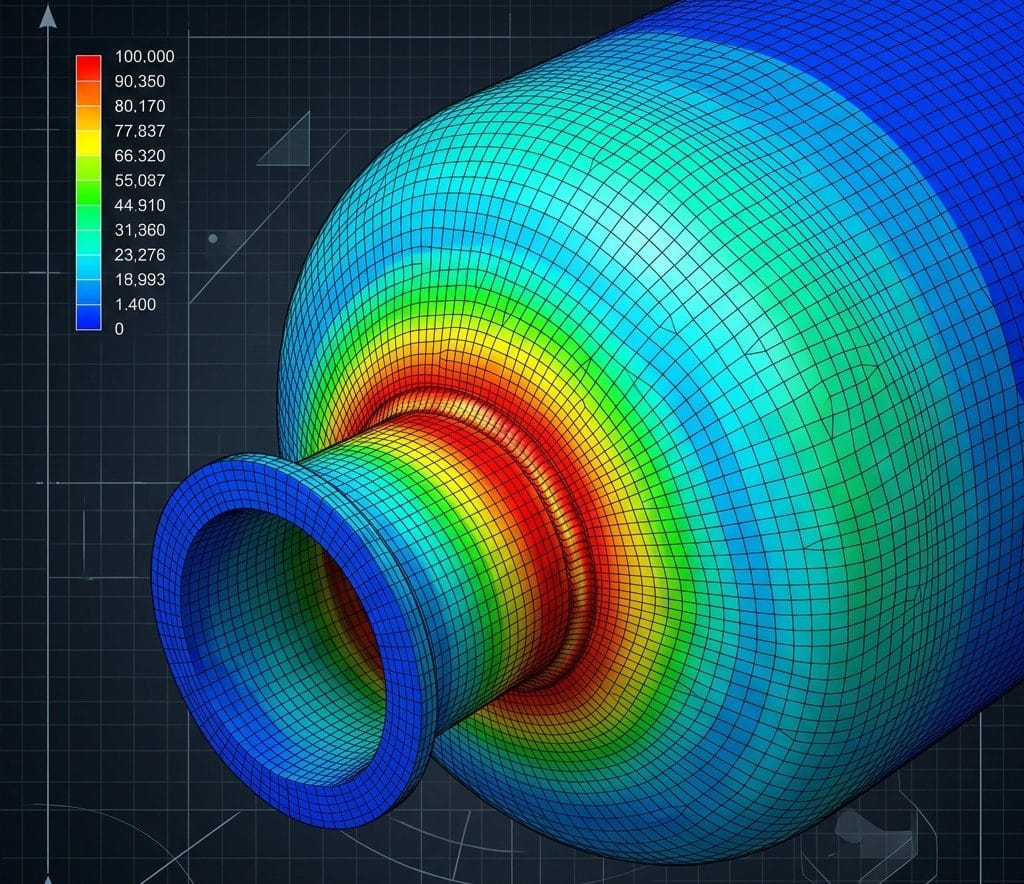
Nozzle Pro (developed by Paulin Research Group) is a specialized finite element analysis software for evaluating local stresses at pressure vessel nozzle connections under applied piping loads. It goes beyond the simplified WRC-107 and WRC-297 bulletin methods to deliver full 3D shell-element FEA calculations accepted by ASME Section VIII Division 2 and recognized by major classification bodies and third-party inspection agencies worldwide.
When piping systems expand thermally or vibrate under operating conditions, they exert forces and moments on the vessels they connect to. If these external loads are too large, they cause localized cracking or plastic deformation at the nozzle-to-shell junction — a failure mode that is invisible to standard pressure vessel design codes but fully captured by Nozzle Pro’s FEA engine.
When is Nozzle Pro Required?
Standard code methods like WRC-107 and WRC-297 are conservative approximations suitable for straightforward geometries and moderate loads. Nozzle Pro becomes essential in these specific engineering situations:
- Large Nozzle-to-Shell Diameter Ratios: When d/D exceeds 0.5, WRC bulletin methods lose accuracy and FEA is required per ASME Div 2.
- High External Piping Loads: When CAESAR II reports nozzle loads that exceed WRC allowable limits, Nozzle Pro provides a rigorous re-evaluation that often proves the design is actually acceptable.
- Non-Radial Nozzles: Hillside, tangential, or angled nozzle connections that cannot be evaluated by WRC bulletin geometry assumptions.
- High-Cycle Fatigue Assessment: Equipment subject to repeated pressure cycling or thermal transients requiring a full ASME fatigue life evaluation.
- Division 2 Compliance: Projects where the governing code is ASME Section VIII Division 2, which mandates rigorous stress categorization and FEA-based assessment.
WRC-107 vs. Nozzle Pro FEA: A Technical Comparison
| Evaluation Method | WRC-107 / WRC-297 | Nozzle Pro FEA |
|---|---|---|
| Applicable Code | ASME Div 1 (simplified design by rule) | ASME Div 1 & Div 2, EN 13445, PD 5500 |
| Geometry Limits | d/D < 0.5, radial nozzles only | Any geometry — hillside, tangential, angled |
| Stress Type | Membrane and bending stress resultants | Full 3D shell stress tensor with primary/secondary categorization |
| Fatigue Assessment | Not included | Full ASME fatigue curve analysis available |
| Conservatism | Highly conservative — often rejects valid designs | Rigorous — can prove acceptability that WRC cannot |
Engineering Tip: Before redesigning an entire piping system to reduce nozzle loads, always run Nozzle Pro first. In many cases a WRC-107 “failure” is actually a conservatism failure — the nozzle passes the more rigorous FEA evaluation with significant margin remaining.
How Nozzle Pro Fits Into Our Engineering Workflow
Nozzle Pro operates at the critical interface between our piping design and stress analysis work and our static equipment mechanical design. The process flows as follows:
- CAESAR II generates nozzle loads — the piping stress model exports applied forces and moments (Fx, Fy, Fz, Mx, My, Mz) at each vessel connection point.
- WRC screening performed in PV Elite — a quick check determines whether the loads are within simplified code limits.
- Nozzle Pro model built — the nozzle geometry, vessel shell parameters, and material properties are entered into the FEA environment.
- FEA load cases applied — sustained, thermal expansion, and occasional loads applied per ASME load combination rules.
- Stress categories evaluated — primary membrane, primary bending, and secondary stresses are categorized and compared to ASME allowable limits.
- Report issued for design record — a fully referenced FEA report is included in the equipment file for regulatory and third-party inspection review.
Frequently Asked Questions
What is WRC-107 analysis?
WRC-107 (Welding Research Council Bulletin 107) is a widely used simplified method for calculating local stresses at pressure vessel nozzle connections due to external piping loads. It uses influence coefficient tables to estimate stress resultants — but its applicability is limited to certain geometries and load magnitudes.
When does Nozzle Pro give different results from WRC-107?
Nozzle Pro typically gives less conservative (more accurate) results than WRC-107 for large nozzles or high loads, because its 3D shell FEA captures stress redistribution that the simplified WRC charts cannot model. This means a nozzle that “fails” on WRC-107 may actually pass on Nozzle Pro — saving costly piping redesigns.
Is Nozzle Pro accepted by inspection authorities?
Yes. Nozzle Pro FEA results are widely accepted by Authorized Inspection Agencies (AIAs), classification societies (DNV, Lloyd’s, Bureau Veritas), and major oil company engineering standards as a rigorous basis for pressure vessel nozzle qualification.
What is the difference between Nozzle Pro and ANSYS for FEA?
Nozzle Pro is purpose-built for pressure vessel nozzle analysis per ASME codes — it is faster, pre-configured for code-compliant stress categorization, and requires less FEA expertise to operate. ANSYS is a general-purpose FEA platform capable of solving virtually any structural, thermal, or fluid problem, but requires more setup time and FEA expertise to produce code-compliant results for vessel components.
Resolve Your Nozzle Load Problems with Confidence
If your project has nozzle loads that exceed WRC-107 limits, do not automatically accept a costly piping redesign. Let our engineering team run a Nozzle Pro FEA assessment first — we consistently find that the vessel is structurally sound and that the real issue is analytical conservatism, not an actual design deficiency.