PV Elite: The Industry Standard for Pressure Vessel Design
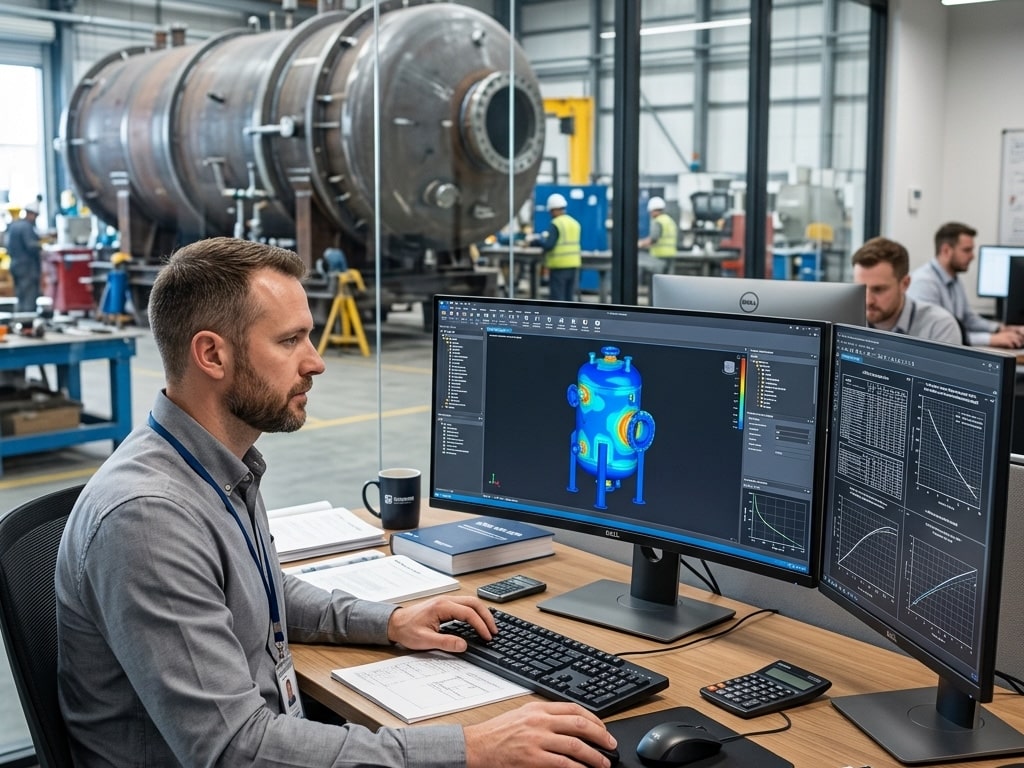
When structural failure is not an option, engineers rely on PV Elite software to validate every critical dimension of a pressure vessel before a single weld is made. As part of our engineering design and consultancy services, PV Elite sits at the core of our static equipment design workflow, ensuring every vessel, tower, and heat exchanger we engineer meets the exact letter of international codes.
What is PV Elite Software?
PV Elite (developed by Hexagon PPM) is the globally recognized engineering software for the complete mechanical design and analysis of pressure vessels, heat exchangers, and towers. It automatically applies the rules of major international codes — primarily ASME Section VIII Div 1 and Div 2, but also PD 5500 and EN 13445 — to confirm that every component passes structural integrity verification.
PV Elite does not replace the engineer — it amplifies his precision. The software translates raw process conditions (design pressure, temperature, fluid density) into exact material thicknesses, head geometries, and nozzle reinforcement requirements that would take weeks to calculate by hand.
Key Engineering Capabilities of PV Elite
PV Elite covers the full mechanical design scope of any pressure-retaining vessel, from initial concept to the finalized fabrication drawing package.
- Shell & Head Design: Calculates minimum required wall thickness for cylindrical shells, ellipsoidal, hemispherical, and conical heads under internal and external pressure.
- Nozzle Analysis: Evaluates area replacement requirements and local stress states at every opening, ensuring that nozzle loads from connected piping stress analysis do not overstress the shell.
- Support Design: Engineers saddles, legs, and lugs to handle dead weight, wind, and seismic loads.
- Heat Exchanger Mechanical Design: Designs tube sheets, flanges, baffles, and channel covers per ASME and TEMA standards.
- Lifting & Transportation Loads: Verifies structural adequacy for field lifting, shipping, and installation scenarios.
PV Elite vs. Manual ASME Calculations: A Comparison
| Engineering Task | Manual Method | PV Elite Advantage |
|---|---|---|
| Shell thickness | Manual formula application per code | Instant multi-load-case iteration with automatic code updates |
| Nozzle reinforcement | Error-prone spreadsheet calculations | Automated area replacement per UG-37 with full audit trail |
| Weight & CoG | Estimated from geometry approximations | Precise operating, empty, and test weight with center-of-gravity data |
| Wind & seismic loads | Requires separate structural analysis | Integrated ASCE/UBC seismic and wind code modules |
| Compliance report | Manually formatted PDF | Auto-generated, stamped engineering calculation package |
Critical Note: PV Elite produces the mechanical design, but the thermal performance of a shell and tube heat exchanger must first be validated separately using HTRI before the mechanical sizing can begin. Never skip the thermal rating step.
How We Use PV Elite in a Real Project Workflow
In our static equipment design process, PV Elite is always preceded by process simulation data from Aspen HYSYS and thermal sizing from HTRI. Here is the exact sequence:
- Receive process datasheet — design pressure, temperature, fluid composition from the process simulation team.
- Enter geometry into PV Elite — shell diameter, nozzle locations, orientation, and material codes.
- Run ASME code check — PV Elite flags any under-thickness shells or inadequate nozzle reinforcement instantly.
- Import external nozzle loads — piping loads from CAESAR II are applied to every nozzle to check combined stress states.
- Generate calculation report — a fully referenced, code-stamped document is issued to the procurement and vendor review team for technical bid evaluation.
Supported International Design Codes
One of PV Elite’s most powerful features is its ability to switch between international code editions within the same project file. We commonly use:
- ASME Section VIII Division 1 — the most widely used standard globally for pressure vessels under 3,000 psi.
- ASME Section VIII Division 2 — for high-pressure applications requiring advanced design-by-analysis to save material cost.
- PD 5500 — the British Standard for unfired pressure vessels, commonly required for UK and Middle East projects.
- EN 13445 — the European Standard, mandatory for CE-marked vessels sold into European markets.
Frequently Asked Questions
What does PV Elite stand for?
PV Elite stands for Pressure Vessel Elite. It is a product developed by Hexagon PPM (formerly Intergraph) and is the global industry standard for mechanical design of pressure-retaining equipment per ASME and other major codes.
Is PV Elite the same as CodeCalc?
PV Elite and CodeCalc are companion products from Hexagon. PV Elite handles the complete vessel model — including all components simultaneously — while CodeCalc was traditionally used to evaluate individual components in isolation. Most modern projects use PV Elite exclusively.
Can PV Elite design ASME Div 2 vessels?
Yes. PV Elite fully supports ASME Section VIII Division 2 design-by-rule calculations. For the more complex design-by-analysis methodology (FEA), a dedicated tool like ANSYS or Nozzle Pro is required alongside PV Elite.
Who needs PV Elite engineering services?
Any company procuring, fabricating, or operating pressure vessels — in oil and gas, petrochemical, power, or pharmaceutical industries — needs certified PV Elite calculations to prove code compliance with regulatory bodies and insurance inspectors.
Get Code-Compliant Pressure Vessel Engineering
Whether you need a complete PV Elite calculation package for a new shell and tube heat exchanger, a verification review for a purchased vessel, or full ASME nozzle load assessment, our engineering team delivers fast, accurate, and fully documented results. Explore our full static equipment design services to learn more.