Plate Heat Exchangers in District Cooling and Heat Pump Systems
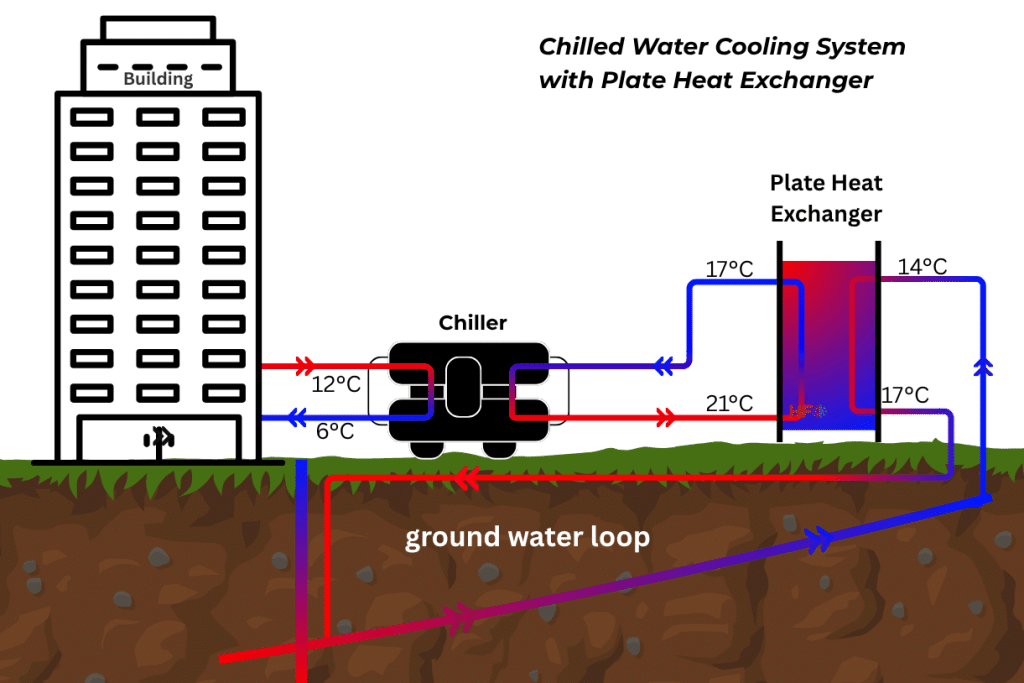
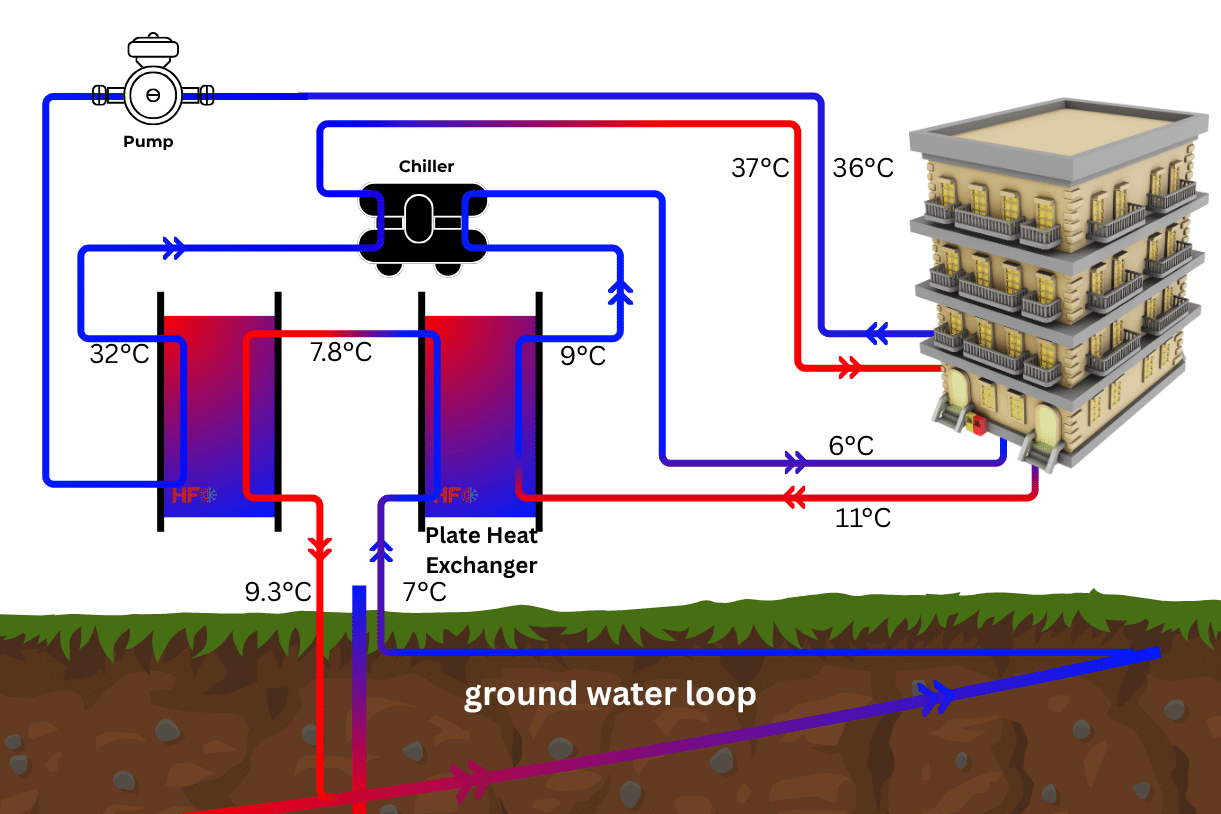
A plate heat exchanger connects district cooling, heat pump, geothermal, mine water, or seawater loops to building systems while keeping the fluids separate. It allows energy to move between circuits without transferring dirt, pressure fluctuations, corrosion risk, or chemical treatment from one side to the other.
This is why plate heat exchangers are common in modern low-carbon heating and cooling networks. They make it possible to combine active cooling, passive cooling, heat recovery, and hydraulic separation inside one practical plant-room concept.
What the Heat Exchanger Does in a District Cooling Connection
In district cooling, the utility network supplies chilled water or cool water to a building energy station. The plate heat exchanger transfers cooling into the building loop. The network water returns warmer to the central plant, while the building chilled water circulates independently.
- Network side: district cooling supply and return.
- Building side: chilled water loop for AHUs, fan coils, or process users.
- Main benefit: cooling delivery without mixing water between owner, operator, and customer systems.
What the Heat Exchanger Does in a Heat Pump System
In a heat pump system, the plate heat exchanger may be installed on the evaporator side, the condenser side, or both. On the evaporator side, it protects the heat pump from source water such as mine water, river water, seawater, or groundwater. On the condenser side, it transfers useful heat to a building or district heating loop.
A heat pump uses a compressor to lift heat from a lower temperature to a higher temperature. A plate heat exchanger does not create that temperature lift; it only transfers heat between two circuits. In many projects, both are needed.
Passive Cooling Before Active Cooling
Passive cooling is possible when the source water is colder than the building return water. In that case, a plate heat exchanger can remove part of the cooling load before the chiller or heat pump starts working.
Building return water: 13 C
Source water: 7 C to 10 C
Result: useful cooling can be transferred through a heat exchanger
This arrangement can reduce compressor energy and may reduce the required heat pump or chiller size. The limiting factor is the temperature approach. If the source water is only slightly cooler than the building return, the exchanger needs more surface area.
Application Examples
| Application | How the PHE Is Used | Selection Priority |
|---|---|---|
| District cooling substation | Transfers cooling from network to building | Close approach and accurate flow control |
| Water-source heat pump | Protects evaporator from source water | Fouling, glycol, and freeze protection |
| Mine water cooling | Transfers cooling from mine water to secondary loop | Material compatibility and cleanability |
| Geothermal heating and cooling | Connects ground loop to heat pump or building loop | Seasonal source temperature range |
| Heat recovery between buildings | Moves surplus heat from cooling users to heating users | Control logic and variable loads |
Sizing Checks for District Cooling and Heat Pump Loops
The simplest first check is the heat balance. For water:
Q (kW) = 1.163 x Flow (m3/h) x Delta T (C)If a district cooling exchanger is rated for 1500 kW with a 7 C temperature change, the expected water flow is about 184 m3/h. If one side has glycol, seawater, or a different fluid, the specific heat and density must be corrected.
The second check is approach temperature. District cooling duties often have tight approaches because the building wants the coldest possible supply temperature while the network operator wants the highest possible return temperature. A tight approach increases plate area and can affect price.
Why a Very Small Approach Needs Careful Review
If the required duty is 14 C to 7 C on one side and 6 C to 13 C on the other, the exchanger has only 1 C temperature difference at both ends. That is a demanding duty. It should not be approved from a summary datasheet alone.
- Ask for the native software printout.
- Confirm the inlet and outlet temperatures used in calculation.
- Check plate count, effective area, and pressure drop.
- Confirm fouling factors and glycol concentration.
- Compare against a second selection if the price looks unusually low.
You can use the water to water heat exchanger calculator for an early heat balance check, then validate final selection with manufacturer software.
Best Practice Specification
For district cooling and heat pump projects, the purchase specification should state the exact duty and required performance guarantee. Avoid vague language such as “suitable for cooling” or “as per supplier selection.”
The plate heat exchanger shall deliver 1500 kW at the specified inlet and outlet temperatures, fluid properties, fouling factor, and maximum pressure drop. The manufacturer shall provide the original thermal selection report and guarantee the stated capacity under design conditions.FAQ
Is a district cooling heat exchanger the same as a heat pump?
No. A heat exchanger transfers heat between two fluids. A heat pump uses electricity and a refrigerant cycle to move heat from a lower temperature level to a higher temperature level. Many systems use both devices together.
When is passive cooling possible?
Passive cooling is possible when the source water temperature is lower than the building return temperature by enough margin to transfer useful heat through a heat exchanger. The smaller the temperature difference, the larger the exchanger usually needs to be.
Why are plate heat exchangers common in heat pump systems?
Plate heat exchangers are compact and efficient, and they can isolate expensive heat pump equipment from dirty, corrosive, or high-pressure source water circuits.