Titanium in Heat Exchangers: The Engineering Standard for Extreme Environments
In the high-stakes arena of industrial process engineering, material failure is not merely an inconvenience—it is a catastrophic financial event. While Stainless Steel (AISI 304 and 316) serves as the backbone of the industry, there exists a threshold where these alloys inevitably surrender. When chloride concentrations rise, temperatures spike, and aggressive acids enter the stream, engineering pragmatism points in one direction: Titanium.
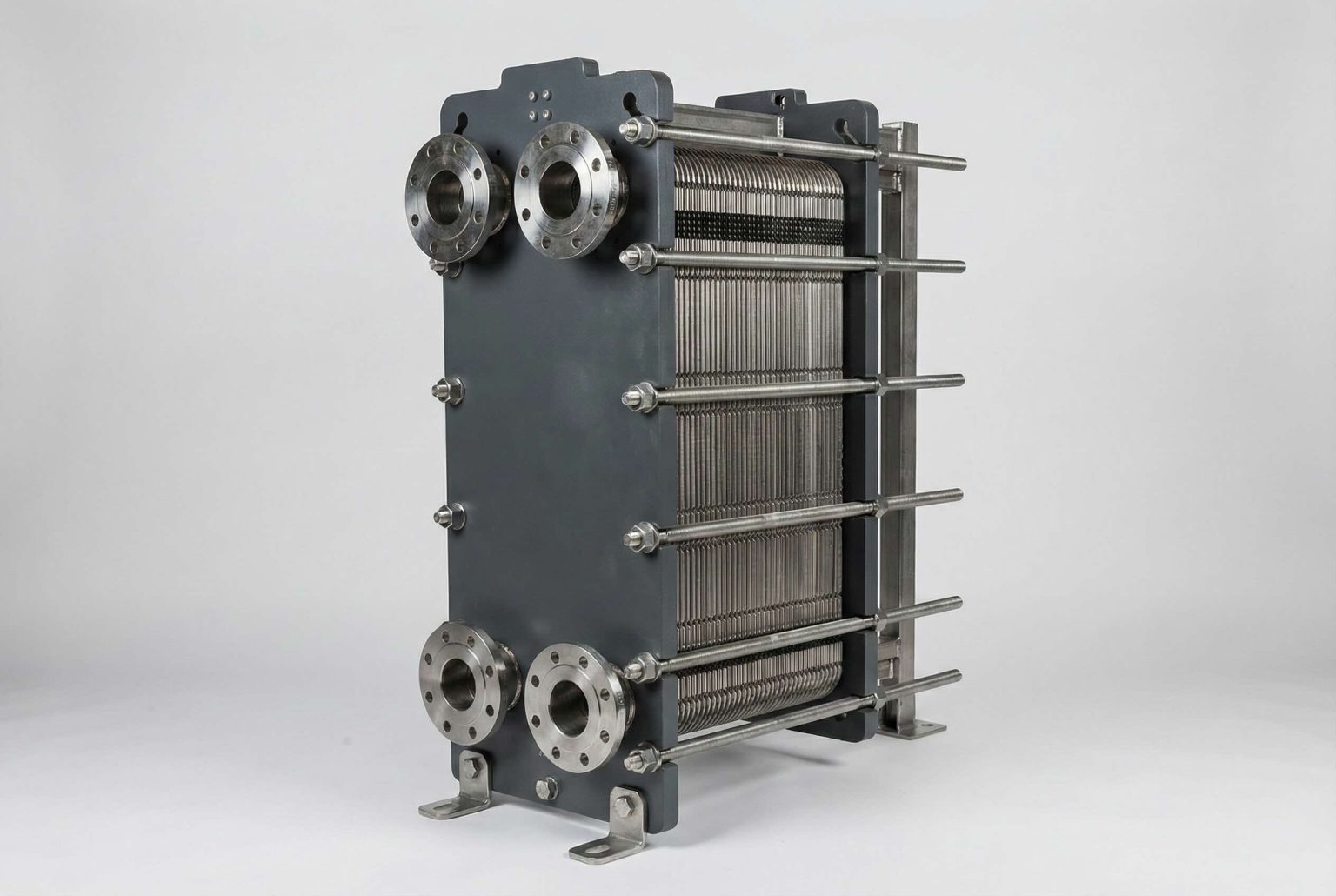
Titanium plate heat exchangers have evolved from exotic, aerospace-grade luxuries to essential components in modern manufacturing and energy sectors. But what makes this transition necessary, and more importantly, is the initial capital expenditure (CAPEX) justified by the operational lifecycle?
Table of Contents
The Science of Invincibility: The Oxide Film
To understand why Titanium is the preferred choice for heat exchanger selection [cite: 33] in hostile environments, one must look at the microscopic level. Titanium is not “corrosion-proof” in the magical sense; rather, it is incredibly reactive.
The moment raw titanium is exposed to oxygen, it instantly forms a tenacious, stable, and self-healing oxide film (primarily TiO₂). Unlike the rust that flakes off carbon steel, this film adheres tightly to the metal substrate. If the surface is scratched or damaged during maintenance, the film reforms in nanoseconds, provided there is a trace amount of oxygen or water present.
Material Comparison: Titanium vs. The Alternatives
A common query in industrial procurement involves the trade-off between cost and longevity. Based on current market trends and search data involving “Hastelloy vs Titanium” [cite: 2] and “AISI 304 vs 316” [cite: 2], we have compiled a comparison to aid in your purchasing decision [cite: 34].
| Material | Chloride Resistance | Relative Cost | Typical Application |
|---|---|---|---|
| AISI 316 (Stainless) | Low to Moderate | $ | Potable water, Dairy, Light oils, HVAC |
| 254 SMO | High | $$$ | Pool heating, Brackish water, Moderate chlorides |
| Titanium (Gr. 1) | Excellent | $$$$ | Seawater cooling, Bleaching, Salt manufacturing |
| Hastelloy C-276 | Superior (Acids) | $$$$$ | Sulfuric acid, extreme chemical processing |
Titanium Applications: Beyond Seawater
While marine cooling is the most recognizable application, the utility of Titanium plate heat exchangers extends deep into the heart of chemical processing and heavy industry.
1. The Chlor-Alkali Industry
In the production of chlorine and caustic soda, wet chlorine gas is notoriously aggressive. Titanium is one of the few metals that can withstand wet chlorine without rapid deterioration. However, dry chlorine causes a rapid, exothermic reaction with titanium—a critical distinction for process engineers to note.
2. Metal Finishing and Surface Treatment
We see significant demand for Titanium units in anodizing processes (Alumite treatment)[cite: 33]. The baths used for surface finishing are often highly acidic and require precise temperature control. A corroded plate in this stage doesn’t just mean a leak; it means the contamination of an expensive chemical bath and ruined product batches. Read more about Alumite treatment applications here [cite: 33].
3. Oil & Gas Refineries
Refineries often utilize “sour water” stripping and handling. The combination of hydrogen sulfide (H₂S)[cite: 7], ammonia, and chlorides at high temperatures creates a lethal cocktail for lower-grade alloys. Titanium heat exchangers provide the necessary reliability to prevent shutdowns in these critical loops.
The Economic Paradox: High CAPEX, Low OPEX
It is undeniable that Titanium plates carry a higher initial price tag than Stainless Steel. However, the calculation changes when viewed through the lens of Lifecycle Cost (LCC).
Consider the cost of a plate failure. It involves:
- Downtime: The halting of production often costs thousands of dollars per hour.
- Cross-Contamination: Leaking cooling water into the product side.
- Maintenance Labor: The hours spent disassembling and re-gasketing.
- Replacement Parts: Buying new plates repeatedly.
By investing in Titanium for aggressive duties, you effectively purchase “insurance” against corrosion. Furthermore, because Titanium has a high strength-to-weight ratio, the plates can often be pressed thinner (0.5mm or 0.6mm). Thinner plates enhance the Overall Heat Transfer Coefficient (U-value)[cite: 2], allowing for a smaller unit footprint to achieve the same thermal duty.
Maintenance Considerations for Titanium Units
While the plates are durable, the maintenance focus shifts to the gaskets. Titanium is often paired with high-performance elastomers like EPDM-HT or Viton (FKM) to match the temperature capabilities of the metal.
One specific caution with Titanium is its susceptibility to hydrogen embrittlement. In processes where galvanic corrosion might generate atomic hydrogen (often due to coupling with dissimilar metals without isolation), the titanium can become brittle and crack. Proper system design and insulation are paramount.
If you are operating aging Titanium units, regular inspection is still required. Need replacements? We supply high-quality spare parts and gaskets [cite: 34] compatible with major brands like Alfa Laval, Tranter, and Sondex.
Frequently Asked Questions
Titanium is primarily used for its superior corrosion resistance, particularly against chlorides found in seawater, and its ability to withstand aggressive acids where Stainless Steel 304 or 316 would suffer from pitting or stress corrosion cracking[cite: 2, 7].
Due to Titanium’s high strength, plates can be pressed as thin as 0.5mm or 0.6mm. This is thinner than many steel equivalents, which improves heat transfer efficiency and reduces the total weight of the unit.
Yes. Titanium has a naturally smooth surface oxide layer that makes it difficult for biological growth (like marine algae) or scale to adhere, reducing the frequency of maintenance compared to rougher metals.
Yes, Titanium is suitable for steam applications, but care must be taken regarding design pressure and fatigue limits, as Titanium has a lower modulus of elasticity than steel. Proper gasket selection (like EPDM-HT) is also critical for steam duties.
Are you dealing with seawater, chlorides, or aggressive acids?
Don’t gamble with material selection. At Heating Formula, we specialize in optimizing industrial thermal processes. Whether you need a new Titanium Plate Heat Exchanger or a retrofit for an existing system, our engineering team is ready to assist.