Shell and Tube Heat Exchangers: Complete Guide to Design, Types, Materials, Selection and Applications
What is a shell and tube heat exchanger?
A shell and tube heat exchanger is an industrial heat exchanger that transfers heat between two fluids without allowing them to mix. One fluid flows through a bundle of metal tubes, while the second fluid flows around the tubes inside a cylindrical shell. Heat passes through the tube walls from the hotter fluid to the colder fluid, making the equipment suitable for heating, cooling, condensation, evaporation, and heat recovery.
Shell and tube heat exchangers are widely used because they can handle high pressure, high temperature, large flow rates, steam service, dirty or fouling fluids, and demanding industrial processes. They are commonly found in condensers, reboilers, oil coolers, chemical plants, power plants, HVAC systems, marine systems, and general heating and cooling applications.
In a shell and tube heat exchanger, the fluid flowing inside the tubes is called the tube-side fluid, while the fluid flowing around the tubes inside the shell is called the shell-side fluid. This simple but robust design makes shell and tube heat exchangers one of the most reliable and versatile heat exchanger types for industrial use.
Shell and Tube Heat Exchanger Quick Facts
| Main function | Transfers heat between two fluids |
| Main parts | Shell, tube bundle, tubesheets, baffles, heads, nozzles |
| Common types | Fixed tubesheet, U-tube, floating head |
| Best for | High pressure, high temperature, large flow rates, industrial processes |
| Common uses | Condensers, reboilers, oil coolers, steam heaters, process cooling |
| Key standards | TEMA, ASME, ISO, API |
Why Are Shell and Tube Heat Exchangers Used and Where Are They Applied?
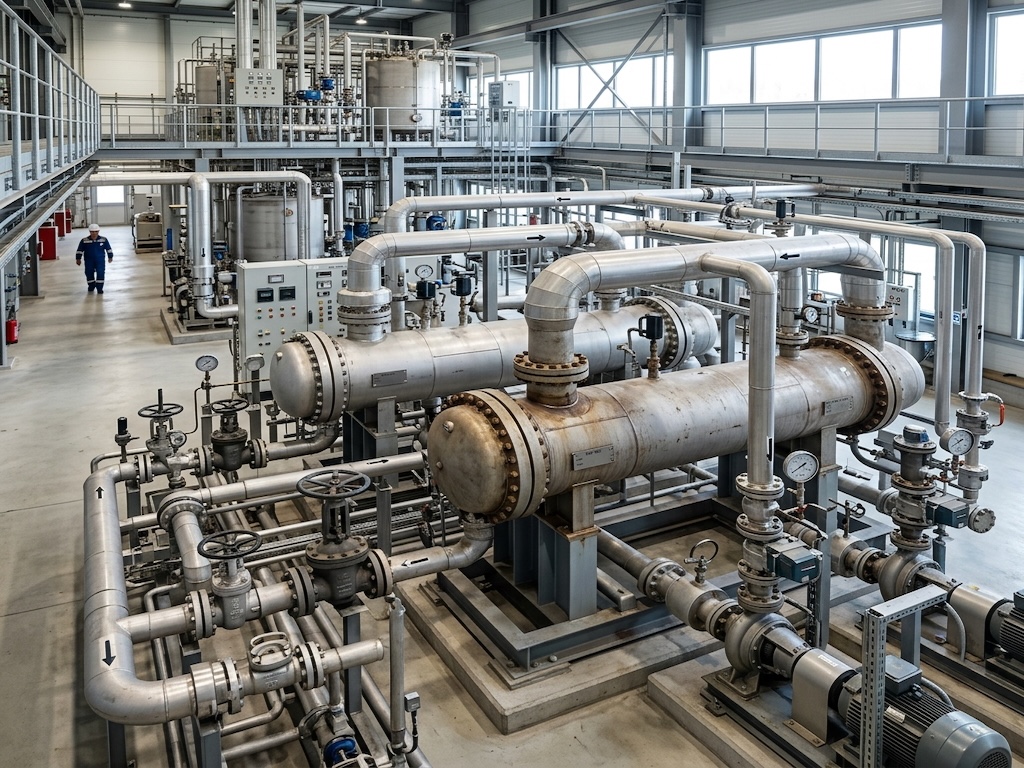
A shell and tube heat exchanger is mostly used because it can handle high pressure, high temperature, large flow rates, and demanding industrial fluids. Its robust design, flexible material options, easy maintenance, and long service life make it one of the most reliable heat exchanger types for power plants, refineries, chemical processes, HVAC systems, marine cooling, and industrial heating or cooling applications.
Main Components of a Shell and Tube Heat Exchanger
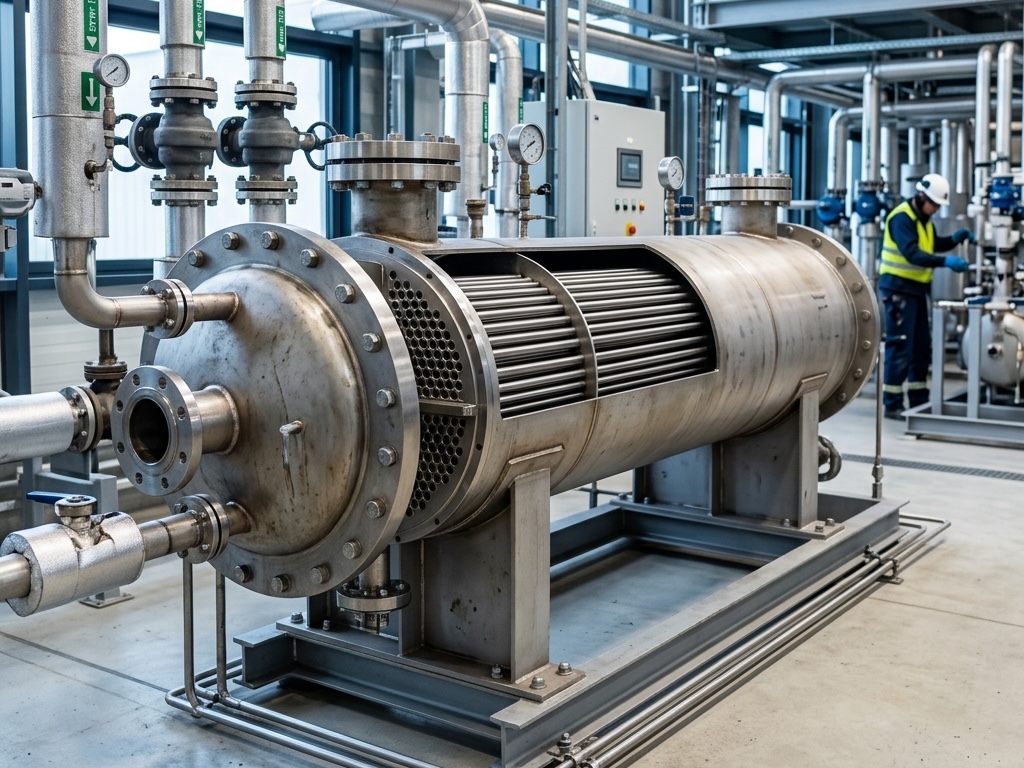
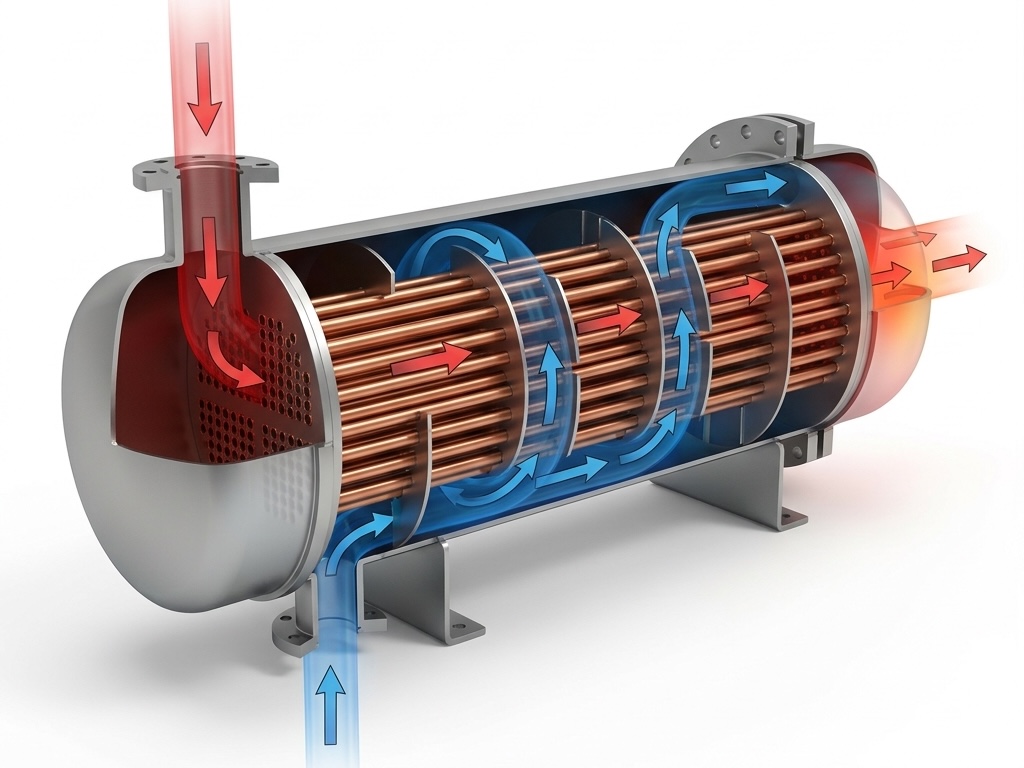
The main components are the shell, tube bundle, tubesheets, baffles, heads, nozzles, gaskets, and supports.
The shell is the outer pressure vessel that contains the shell-side fluid. The tubes carry the tube-side fluid and provide the main heat transfer surface. Tubesheets hold the tubes in position and separate the tube-side fluid from the shell-side fluid. Baffles support the tubes, reduce vibration, and guide the shell-side flow across the tube bundle to improve heat transfer.
The front and rear heads, also called channels, distribute the tube-side fluid into and out of the tubes. Nozzles connect the exchanger to the piping system. Gaskets, pass partitions, tie rods, spacers, and supports complete the mechanical assembly.
How Does a Shell and Tube Heat Exchanger Work?
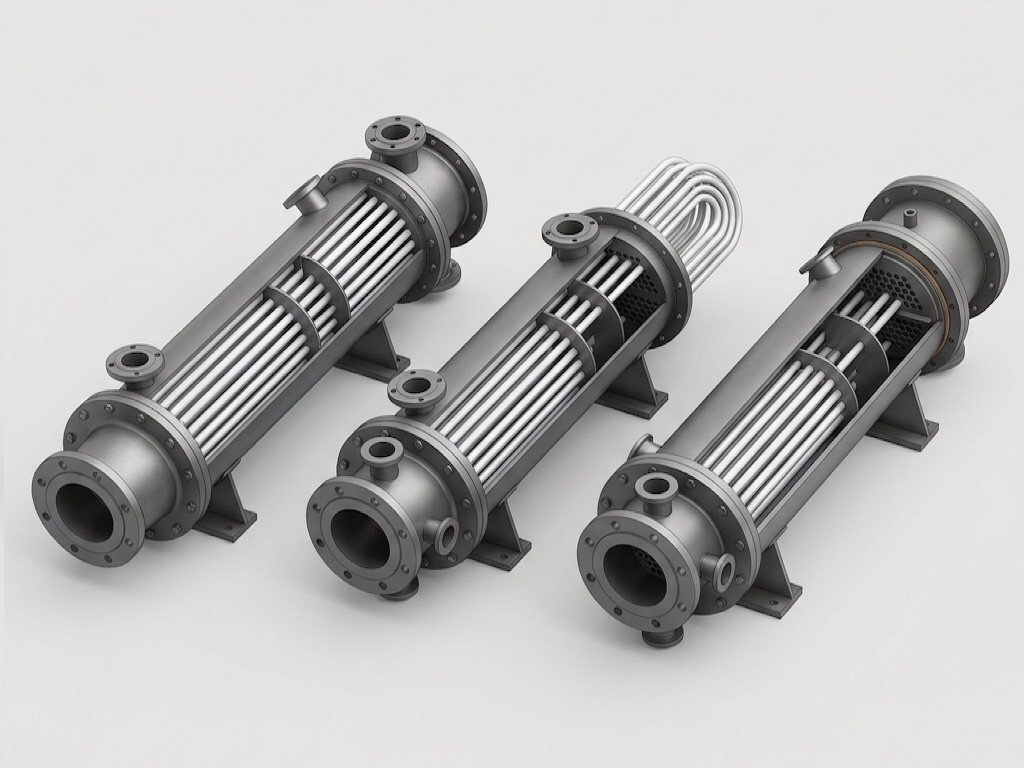
A shell and tube heat exchanger works by combining conduction and convection.
First, heat transfers by convection from the hot fluid to one side of the tube wall. Then heat conducts through the tube wall. Finally, heat transfers by convection from the other side of the tube wall into the colder fluid.
The heat transfer rate depends on the temperature difference, flow rate, fluid properties, tube material, tube surface area, fouling resistance, flow arrangement, and overall heat transfer coefficient.
A simplified heat exchanger design relationship is:
Q = U × A × LMTD × F
Where Q is heat duty, U is the overall heat transfer coefficient, A is heat transfer area, LMTD is the log mean temperature difference, and F is the correction factor for multi-pass arrangements.
For early design checks, use the Heat Exchanger Calculator and the U-Value Thermal Resistance Calculator.
Common Shell and Tube Heat Exchanger Types
Shell and tube heat exchangers are available in several mechanical designs. The most common are fixed tubesheet, U-tube, and floating head designs.
A fixed tubesheet heat exchanger is simple, strong, and cost-effective. The tubesheets are fixed to the shell, making it suitable for clean services and moderate temperature differences. However, shell-side mechanical cleaning is limited, and thermal expansion must be considered.
A U-tube heat exchanger uses tubes bent into a U shape. This design handles thermal expansion well and allows the tube bundle to be removed. It is often used in steam, oil, and process heating applications. The limitation is that cleaning the inside of the U-bends can be more difficult.
A floating head heat exchanger allows one end of the tube bundle to move independently. This design handles thermal expansion and allows easier shell-side cleaning, making it suitable for dirty or fouling services. It is usually more expensive than fixed tubesheet or U-tube designs.
TEMA Designations and Classes
TEMA, the Tubular Exchanger Manufacturers Association, standardizes many shell and tube heat exchanger configurations. A TEMA designation usually uses three letters. The first letter identifies the front head type, the second identifies the shell type, and the third identifies the rear head type.
For example, BEM, BEU, and AES are common TEMA-style designations. BEM typically indicates a bonnet front head, one-pass shell, and fixed rear head. BEU indicates a U-tube rear arrangement. AES indicates a removable channel, one-pass shell, and floating head arrangement.
TEMA also uses three main construction classes: TEMA C for general commercial service, TEMA B for chemical service, and TEMA R for refinery and heavy-duty process service.
Shell-Side and Tube-Side Fluid Selection
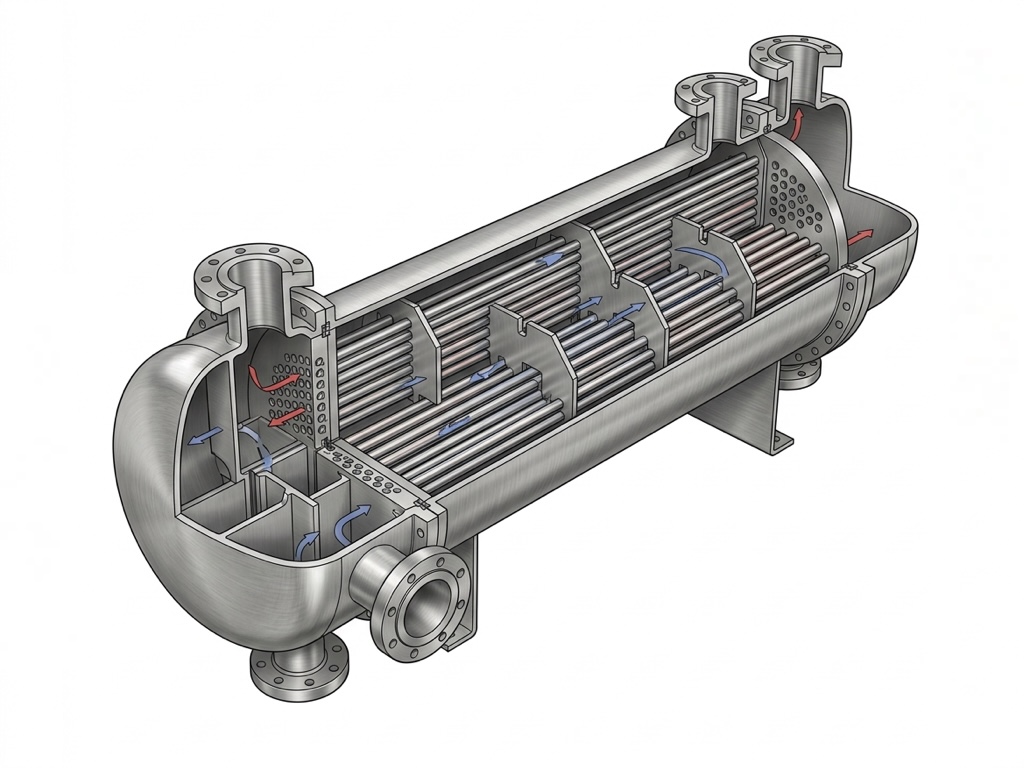
Choosing which fluid goes through the tubes and which fluid goes through the shell is a critical design decision.
High-pressure fluids are often placed on the tube side because tubes can usually handle pressure more economically than a large shell. Corrosive fluids may also be placed on the tube side to reduce the amount of expensive alloy material required. Dirty or fouling fluids are often placed where cleaning is easiest, which may be the tube side for straight-tube cleaning or the shell side when a removable bundle is selected.
The best choice depends on pressure, temperature, corrosion, fouling, viscosity, flow rate, maintenance access, safety, and cost.
Materials Used in Shell and Tube Heat Exchangers
Material selection depends on fluid chemistry, corrosion risk, design temperature, pressure, chloride content, erosion potential, hygiene requirements, and budget.
Carbon steel is widely used for shells and general industrial service. Stainless steel grades such as 304 and 316 are used where corrosion resistance is needed. Duplex stainless steels are used for stronger chloride resistance. Copper alloys, brass, bronze, and copper-nickel are common in marine and water applications. Titanium is preferred for seawater and aggressive chloride environments. Nickel alloys such as Hastelloy, Inconel, and Monel are selected for highly corrosive chemical processes.
Correct material selection protects the exchanger from corrosion, leakage, early tube failure, and unplanned shutdowns.
Key Applications
Shell and tube heat exchangers are used across many industries because they are strong, adaptable, and serviceable.
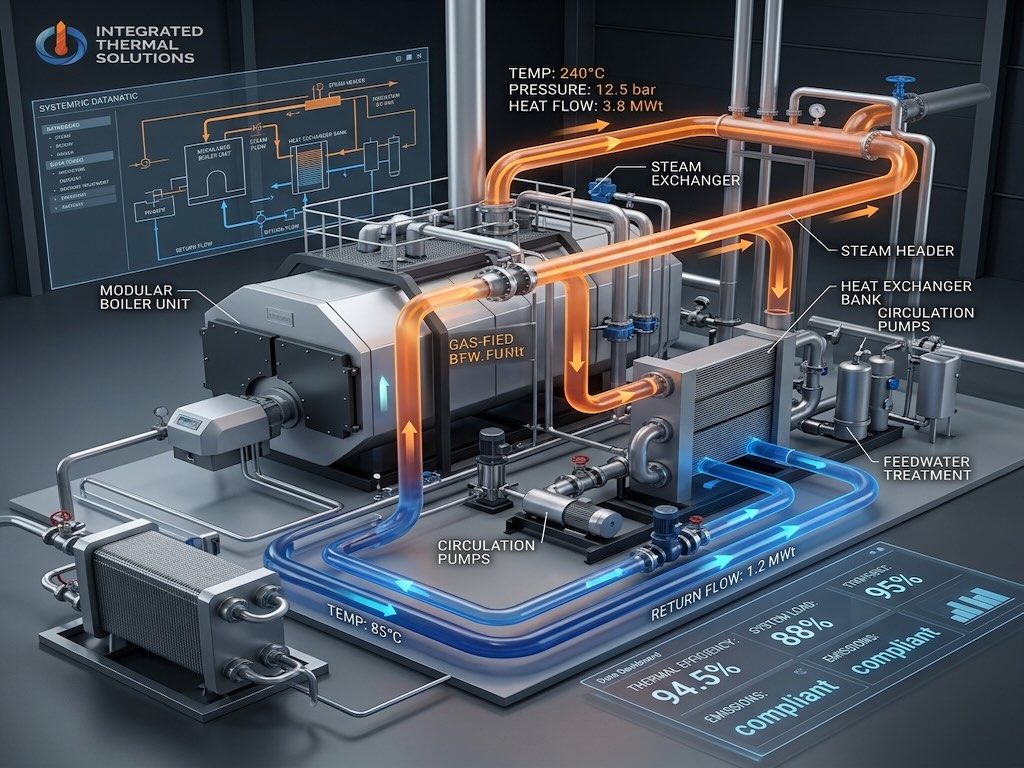
Common applications include oil coolers, steam condensers, process heaters, reboilers, evaporators, hydraulic oil cooling, chemical processing, power plant condensers, marine cooling, engine jacket water cooling, refinery services, HVAC heat transfer, district heating, food processing, and industrial waste heat recovery.
For broader system examples, see Heating and Cooling Applications.
Advantages of Shell and Tube Heat Exchangers
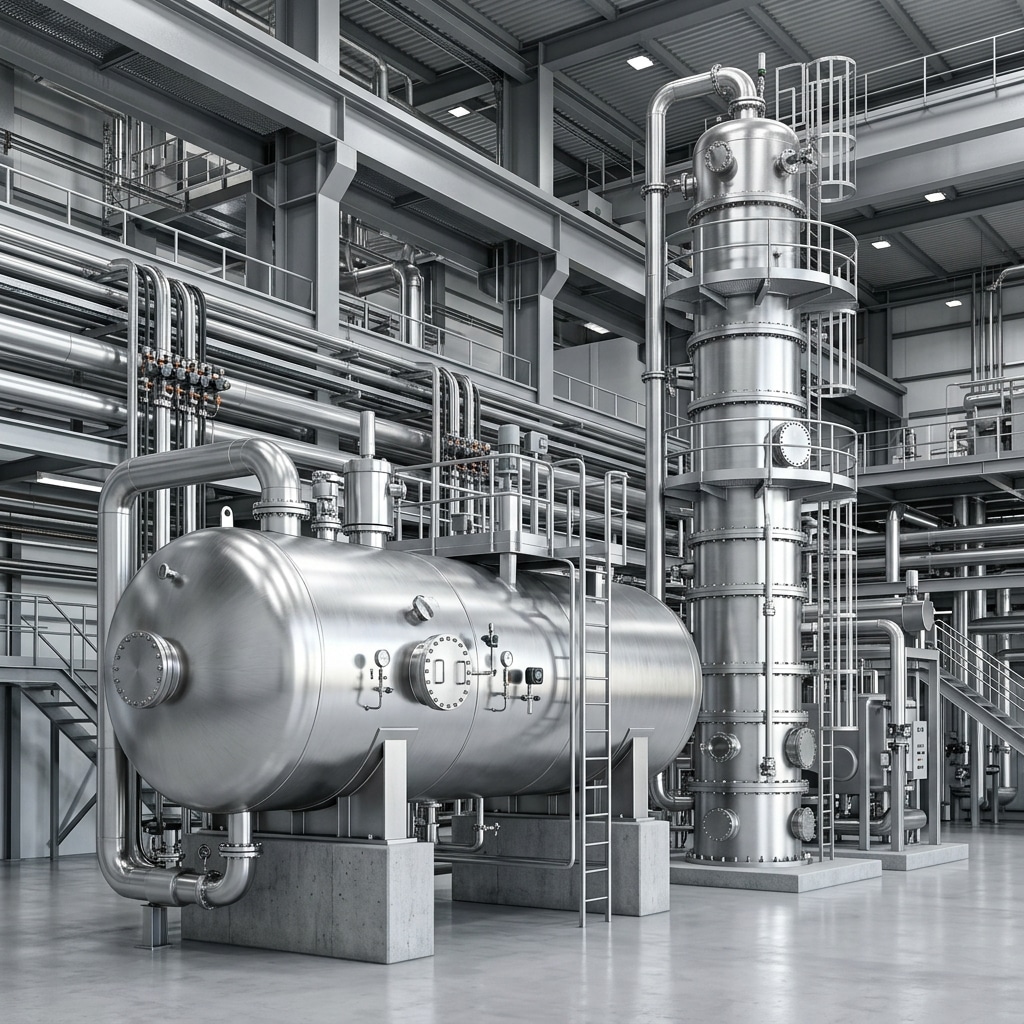
The main advantages are mechanical strength, high pressure capability, high temperature capability, wide material availability, flexible design, large heat transfer capacity, long service life, and good maintainability.
Shell and tube designs are especially valuable where process conditions are severe, fluids are dirty, or the required duty is too large for compact heat exchanger types.
Limitations Compared With Plate Heat Exchangers
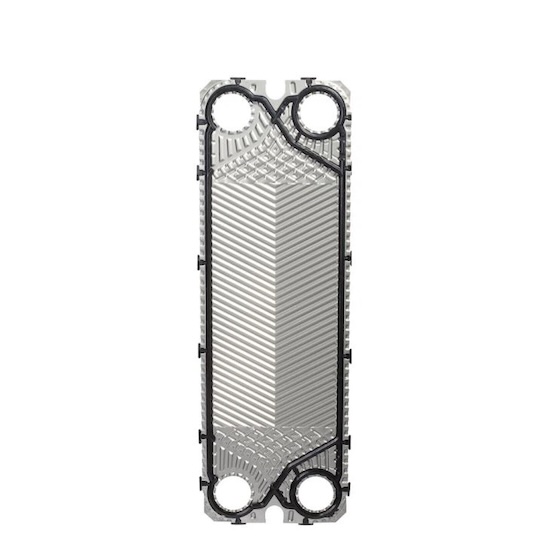
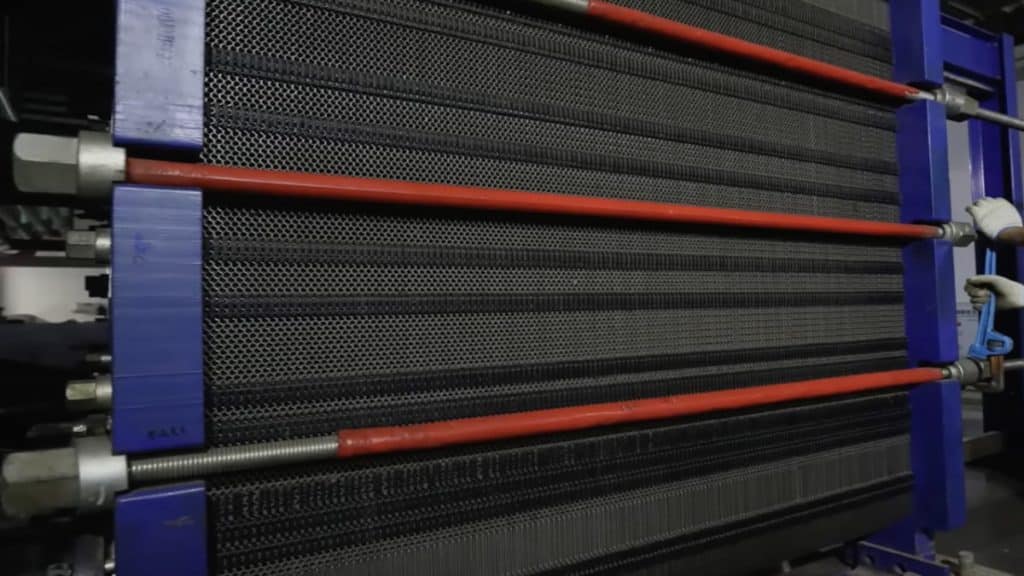
Shell and tube heat exchangers are not always the best choice. Plate heat exchangers are usually more compact and can provide high thermal efficiency with close temperature approaches. They are often easier to expand by adding plates.
However, plate heat exchangers may be limited by gasket compatibility, pressure, temperature, or very dirty services. Shell and tube exchangers are often preferred for steam, high pressure, high temperature, viscous fluids, large flow rates, and heavy industrial applications.
How to Select a Shell and Tube Heat Exchanger
To select the right shell and tube heat exchanger, define the heat duty, inlet and outlet temperatures, fluid properties, allowable pressure drop, design pressure, design temperature, corrosion allowance, fouling factor, material requirements, cleaning method, installation space, and applicable standards.
Important selection questions include: What is the required heat duty? Are the fluids clean or dirty? Is there phase change such as condensation or boiling? What pressure drop is acceptable? Which side needs easier cleaning? Are the fluids corrosive, toxic, or hazardous? Is thermal expansion significant? Which TEMA type is appropriate?
For project-specific support, use HeatingFormula’s Design and Consultancy service or start with the Shell and Tube Heat Exchanger Selection page.
Maintenance, Fouling and Cleaning
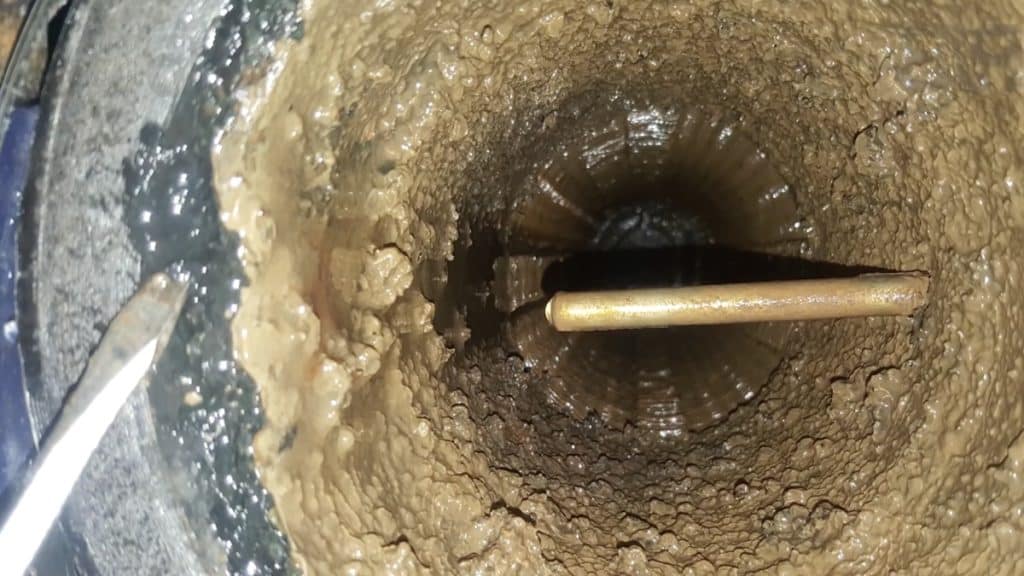
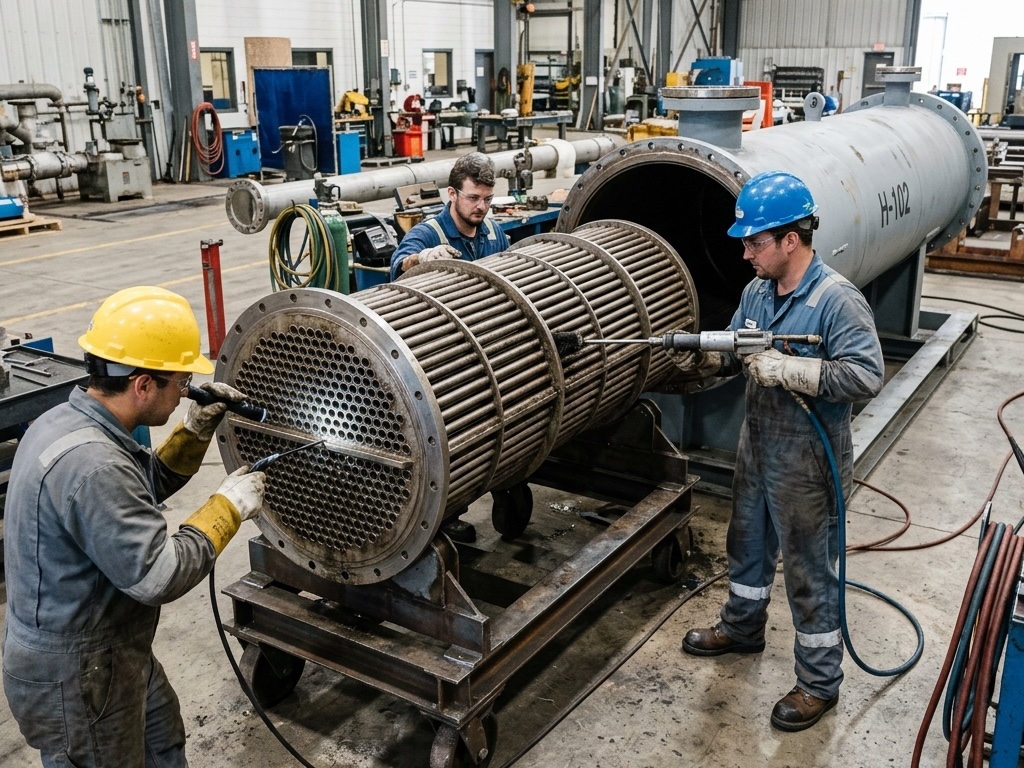
Fouling is one of the most important operating issues in shell and tube heat exchangers. Fouling reduces heat transfer, increases pressure drop, raises energy consumption, and can eventually force a shutdown.
Common fouling types include scaling, biological growth, sediment, corrosion products, polymer deposits, oil sludge, and crystallization. Maintenance can include mechanical tube brushing, hydroblasting, chemical cleaning, bundle pulling, gasket replacement, tube plugging, inspection, hydrotesting, and performance monitoring.
A good maintenance plan tracks outlet temperatures, pressure drop, flow rate, vibration, leakage, and changes in heat duty over time.
Common Failure Causes
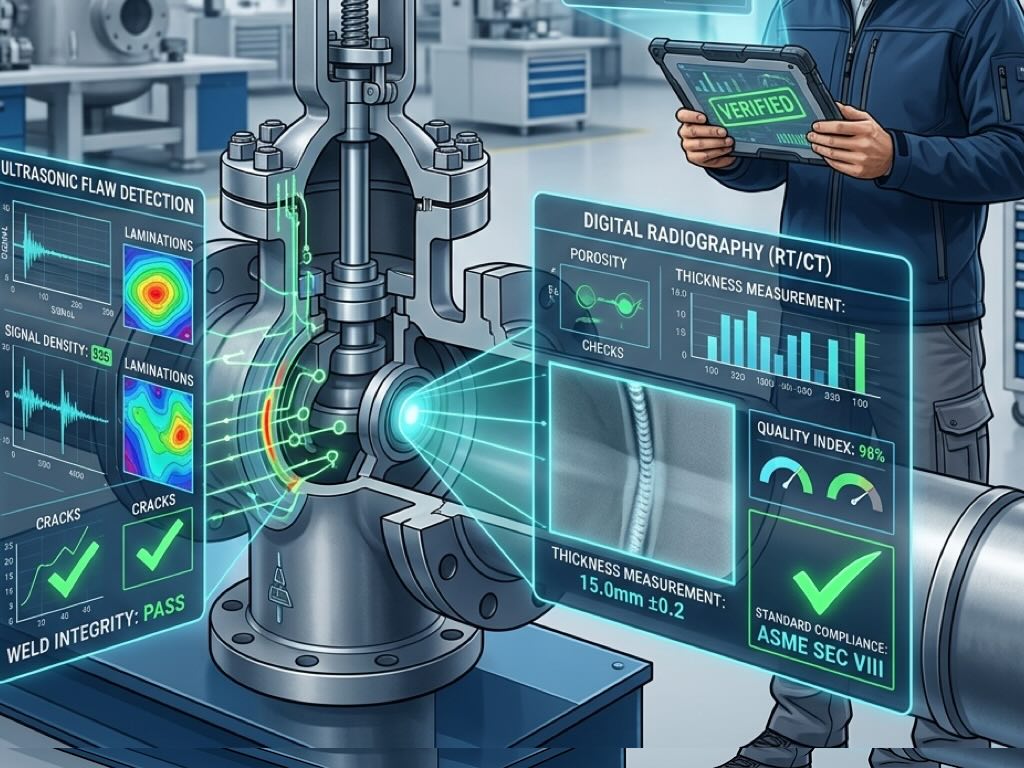
Common shell and tube heat exchanger failures include tube leakage, corrosion, erosion, vibration damage, thermal fatigue, gasket failure, fouling, tube-to-tubesheet joint failure, and incorrect material selection.
Many failures can be reduced with proper thermal design, mechanical design, velocity control, baffle spacing, vibration checks, corrosion allowance, compatible materials, and realistic fouling assumptions.
Conclusion
Shell and tube heat exchangers remain the industrial workhorse of heat transfer because they are durable, flexible, and suitable for demanding process conditions. They can be designed for high pressure, high temperature, large capacity, fouling fluids, steam service, condensation, evaporation, oil cooling, chemical processing, power generation, HVAC, and marine systems.
The right design depends on more than heat duty alone. TEMA type, material selection, fluid allocation, fouling risk, pressure drop, cleanability, thermal expansion, and operating cost all affect long-term performance.
HeatingFormula helps engineers and facility operators evaluate these factors and choose the correct heat exchanger for each application.
Frequently Asked Questions About Shell and Tube Heat Exchangers
What is a shell and tube heat exchanger?
A shell and tube heat exchanger is a device that transfers heat between two fluids. One fluid flows through tubes, while another flows around the tubes inside a shell.
Where are shell and tube heat exchangers used?
They are used in refineries, chemical plants, power stations, HVAC systems, marine systems, food processing, oil cooling, steam condensers, re boilers, and industrial heating or cooling systems.
What are the main types of shell and tube heat exchangers?
The main types are fixed tubesheet, U-tube, and floating head heat exchangers.
Why are shell and tube heat exchangers so common?
They are common because they are robust, reliable, customizable, suitable for high pressure and temperature, and available in many materials and configurations.
What is TEMA in shell and tube heat exchangers?
TEMA is the Tubular Exchanger Manufacturers Association. It provides widely used standards and design classifications for shell and tube heat exchangers.
Which fluid should go in the tubes?
High-pressure, corrosive, hazardous, or easier-to-clean fluids are often placed on the tube side, but the final decision depends on the full process conditions.
What materials are used for shell and tube heat exchangers?
Common materials include carbon steel, stainless steel, duplex stainless steel, copper alloys, titanium, and nickel alloys.
How do you size a shell and tube heat exchanger?
Sizing requires heat duty, temperatures, fluid properties, flow rates, allowable pressure drop, fouling factors, material selection, and heat transfer area calculations.