Heat Exchanger Pricing Guide: What Affects Cost & How to Save
Understand the real cost drivers — material, size, complexity — and smart sourcing strategies to reduce your spend
Heat exchanger pricing is influenced by a complex interplay of material costs, thermal duty, design pressure, manufacturing complexity, and market conditions. Whether you’re budgeting for a single unit or an entire plant, understanding these cost drivers empowers you to negotiate better, specify more economically, and ultimately get the best value.
This guide explains the key factors that determine heat exchanger cost, provides reference price ranges by type and size, and shares practical strategies for reducing your total cost of ownership. For custom pricing, request a quote from our team.
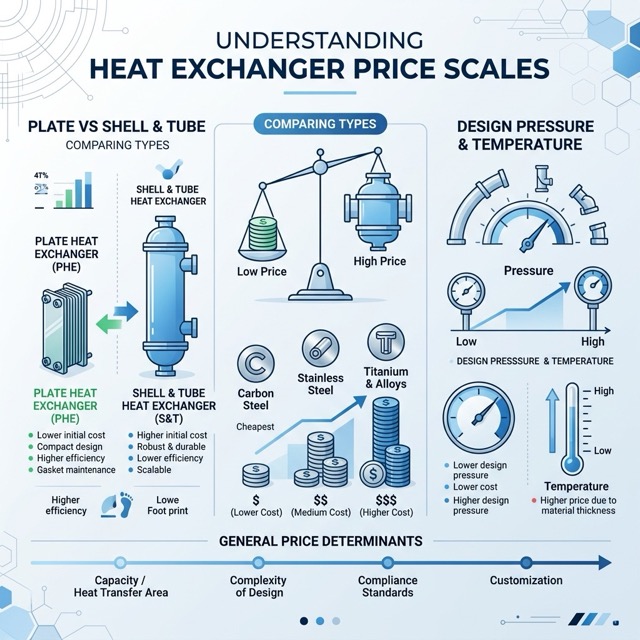
7 Key Factors That Determine Heat Exchanger Price
1️⃣ Material Selection
The single biggest cost driver. Titanium plates cost 3-5× more than AISI 316L; Hastelloy C-276 costs 5-8× more. Choose the right alloy — over-specifying wastes money, under-specifying causes premature failure.
2️⃣ Heat Transfer Area
More area = more plates/tubes = higher cost. Optimizing the U-value and LMTD through proper sizing minimizes the required area.
3️⃣ Design Pressure & Temperature
Higher pressure requires thicker plates/shells and bigger bolts/flanges. Above 25 bar, costs increase 20-50%. Above 100 bar, expect 2-3× standard pricing.
4️⃣ Type Selection
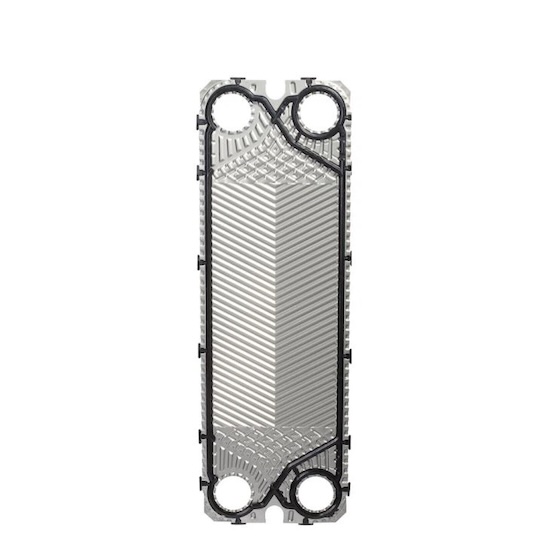
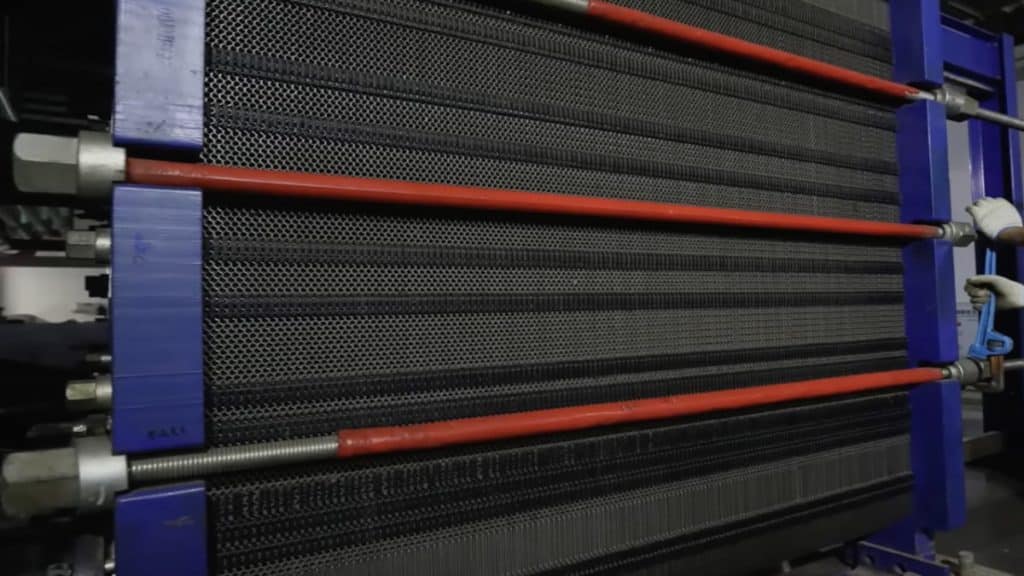
BPHEs are cheapest for small duties. GPHEs are most cost-effective for medium duties. Shell & tube for large/extreme duties. Choosing the right type for the duty optimizes cost.
5️⃣ Gasket Material
NBR (cheapest) vs. EPDM (moderate) vs. Viton (expensive). Viton gaskets can add 30-50% to the gasket cost but are necessary for chemical/high-temp duties.
6️⃣ Certification Requirements
PED, ASME, ATEX, marine classification (DNV/Lloyd’s) certifications add inspection and documentation costs. Budget 10-20% extra for certified units.
7️⃣ Sourcing Location
Manufacturing costs vary by country. Turkey offers 20-40% lower manufacturing costs than EU/US with the same quality standards — making it a preferred sourcing region for heat exchangers.
Indicative Price Ranges by Heat Exchanger Type
| Type | Small Duty | Medium Duty | Large Duty |
|---|---|---|---|
| Brazed Plate (BPHE) | $200 – $800 | $800 – $3,000 | $3,000 – $8,000 |
| Gasketed Plate (GPHE) | $2,000 – $5,000 | $5,000 – $25,000 | $25,000 – $100,000+ |
| Shell & Tube (STHE) | $5,000 – $15,000 | $15,000 – $80,000 | $80,000 – $500,000+ |
| Air-Cooled (Fin-Fan) | $15,000 – $50,000 | $50,000 – $200,000 | $200,000 – $1M+ |
*Prices are indicative ranges for 316L stainless steel construction with standard certifications. Specialty alloys, high pressures, and additional certifications will increase costs. Request exact pricing for your specific requirements.
8 Strategies to Reduce Heat Exchanger Costs
- Right-size the unit: Over-specifying adds 15-40% unnecessary cost. Use accurate sizing calculations instead of “rule of thumb.”
- Choose the right type: Don’t use shell & tube where a plate heat exchanger suffices — GPHEs are 20-40% cheaper for equivalent duties below 180°C.
- Optimize material selection: Use 304 instead of 316L when water quality permits. Don’t specify titanium when 254 SMO would work.
- Source from Turkey: Turkish manufacturers offer EU-quality products at 20-40% lower prices. Same certifications (PED, ASME), shorter lead times.
- Consider total cost of ownership: A cheaper unit that needs frequent gasket replacement costs more over 10 years than a slightly more expensive one with better materials.
- Use aftermarket spare parts: Save 30-50% on replacement plates and gaskets vs. OEM prices.
- Bundle orders: Ordering multiple units or combining with spare parts reduces per-unit cost significantly.
- Plan maintenance proactively: Preventive maintenance costs far less than emergency replacement. Budget for CIP chemicals and periodic gasket sets.
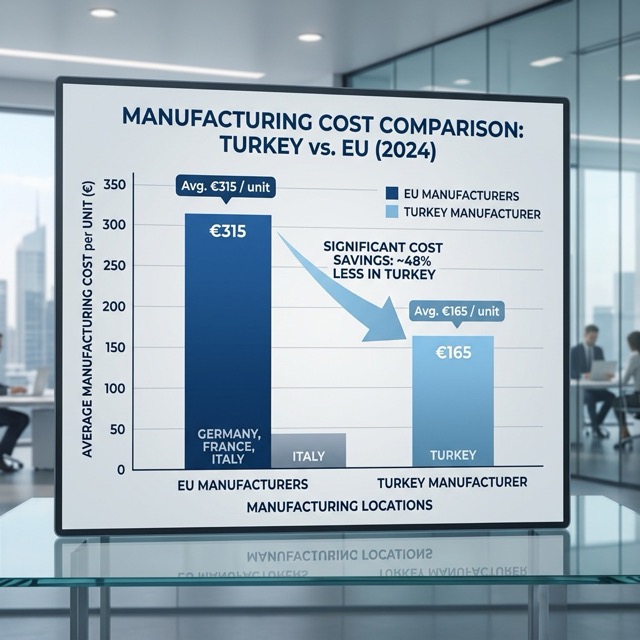
📊 Real-World Savings: GPHE Sourced from Turkey vs. EU
500 kW water-to-water GPHE, 316L plates, EPDM gaskets, PED certified:
EU supplier quote: €12,000 – €15,000
Turkey (HeatingFormula): €7,500 – €9,500
Savings: €3,500 – €5,500 per unit (30-40%)
Same PED certification, same 316L plates, same EPDM gaskets. Lower manufacturing costs + favorable exchange rates.
Frequently Asked Questions
Q: How much does a plate heat exchanger cost?
A gasketed plate heat exchanger (GPHE) with 316L plates typically costs $2,000 – $5,000 for small duties (up to 100 kW), $5,000 – $25,000 for medium duties (100-1,000 kW), and $25,000 – $100,000+ for large duties (1,000+ kW). Exact pricing depends on materials, pressure rating, certifications, and number of plates.
Q: Is a plate heat exchanger cheaper than shell & tube?
For most low-to-medium pressure applications below 180°C, yes — plate heat exchangers are 20-40% cheaper than equivalent shell & tube units. They also require less installation space, lower installation costs, and less foundation work. However, for extreme pressures (>25 bar) or very high temperatures, shell & tube may be more economical.
Q: Why are heat exchangers from Turkey more affordable?
Turkish manufacturers benefit from lower labor costs, competitive raw material sourcing, favorable exchange rates, and government export incentives — while maintaining the same quality standards (ISO, PED, ASME) as European manufacturers. Turkey is now the 4th largest heat exchanger exporter globally.
Get a Competitive Quote Today
Tell us your requirements and receive detailed pricing within 24 hours.