Seawater Heat Exchanger Corrosion: Why Titanium reigns Supreme in Marine Environments
In the maritime and offshore sectors, the cooling medium is often the very thing trying to destroy your equipment: seawater. Standard stainless steels like 316L, while robust for fresh water, rapidly succumb to seawater heat exchanger corrosion through pitting and crevice attacks. For engineers operating in these high-salinity environments, the choice of material isn’t just a technical preference—it’s a multi-million dollar asset protection strategy.
What is the best material for seawater heat exchangers?
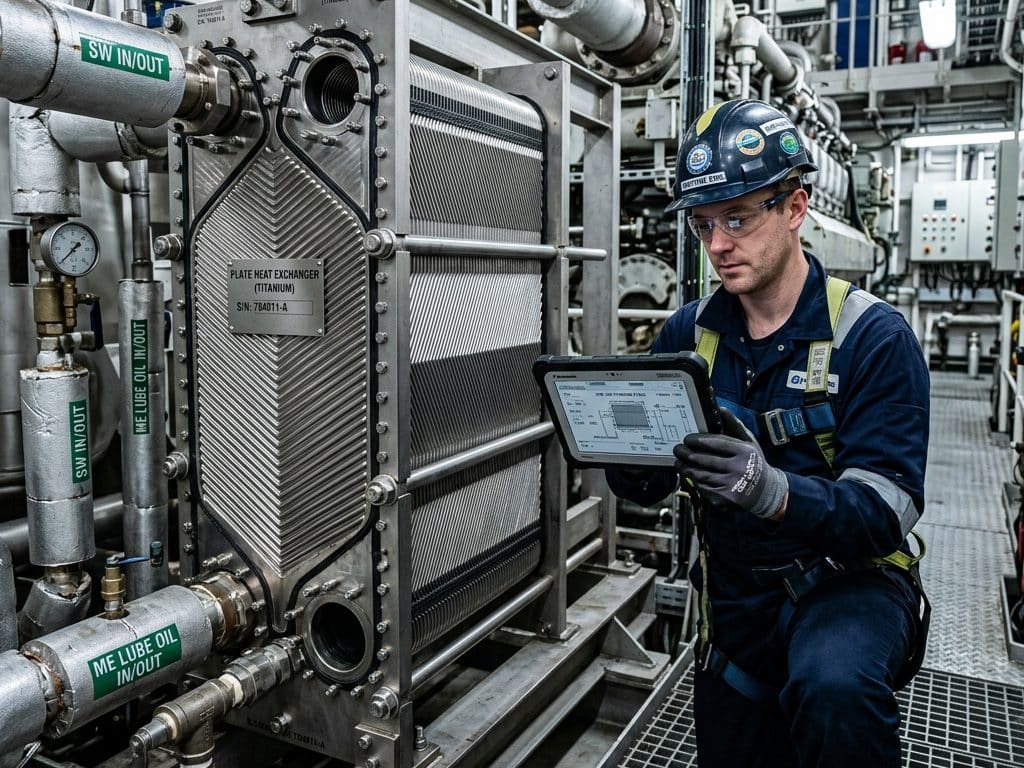
Titanium Grade 1 is the best material for seawater heat exchangers due to its exceptional resistance to chloride-induced pitting and crevice corrosion. With a Pitting Resistance Equivalent Number (PREN) exceeding 60, Titanium remains virtually immune to seawater at all concentrations and temperatures up to 130°C.
The Science of Marine Corrosion Resistance
Seawater contains high concentrations of chloride ions that penetrate the passive chromium-oxide layer of traditional stainless steels. Once this layer is breached, localized corrosion accelerates, leading to pinhole leaks in plates and tubes. Unlike steel, Titanium forms a stable, self-healing TiO2 oxide film that is continuous and tightly adherent. Even if the surface is scratched, the film reforms instantly in the presence of trace oxygen.
| Material | PREN Score | Seawater Application | Estimated Lifespan |
|---|---|---|---|
| 316L Stainless | 25 | Not Recommended | 1-2 Years |
| 904L Stainless | 35 | Moderate Brines | 3-5 Years |
| Titanium Gr 1 | 60+ | Full Immersion | 20+ Years |
Why CAPEX isn’t the whole Story
While the initial cost of a Titanium unit can be 40-50% higher than stainless steel, the Return on Investment (ROI) is staggering. A Titanium seawater heat exchanger eliminates the need for frequent retubing and the catastrophic costs of offshore downtime. In the marine industry, one day of lost production on a rig can exceed the total cost of a Titanium plate pack.
Frequently Asked Questions
While the initial cost of a Titanium unit can be 40-50% higher than stainless steel, the Return on Investment (ROI) is staggering. A Titanium seawater heat exchanger eliminates the need for frequent retubing and the catastrophic costs of offshore downtime. In the marine industry, one day of lost production on a rig can exceed the total cost of a Titanium plate pack.
Is Titanium resistant to biofouling?
While Titanium doesn’t kill marine organisms like copper-nickel alloys do, its smooth oxide surface makes it highly resistant to deposit-induced corrosion underneath bio-slime.
Can Titanium handle high-velocity seawater?
Yes. Titanium is immune to erosion-corrosion at flow velocities up to 30 meters per second, which is far beyond the typical operational speed of plate heat exchangers.