CAESAR II: Piping Stress Analysis & ASME B31 Code Compliance
When a pipe carrying 400°C steam expands by several centimeters, the forces it exerts on its supports and connected equipment can be catastrophic if not properly managed. CAESAR II is the world’s leading piping stress analysis software, and it is the engineering tool that our team uses to predict, quantify, and eliminate these forces before they reach the real plant. It is the cornerstone of our piping design and stress analysis services and one of the most consequential tools in our full engineering design and consultancy suite.
What is CAESAR II?
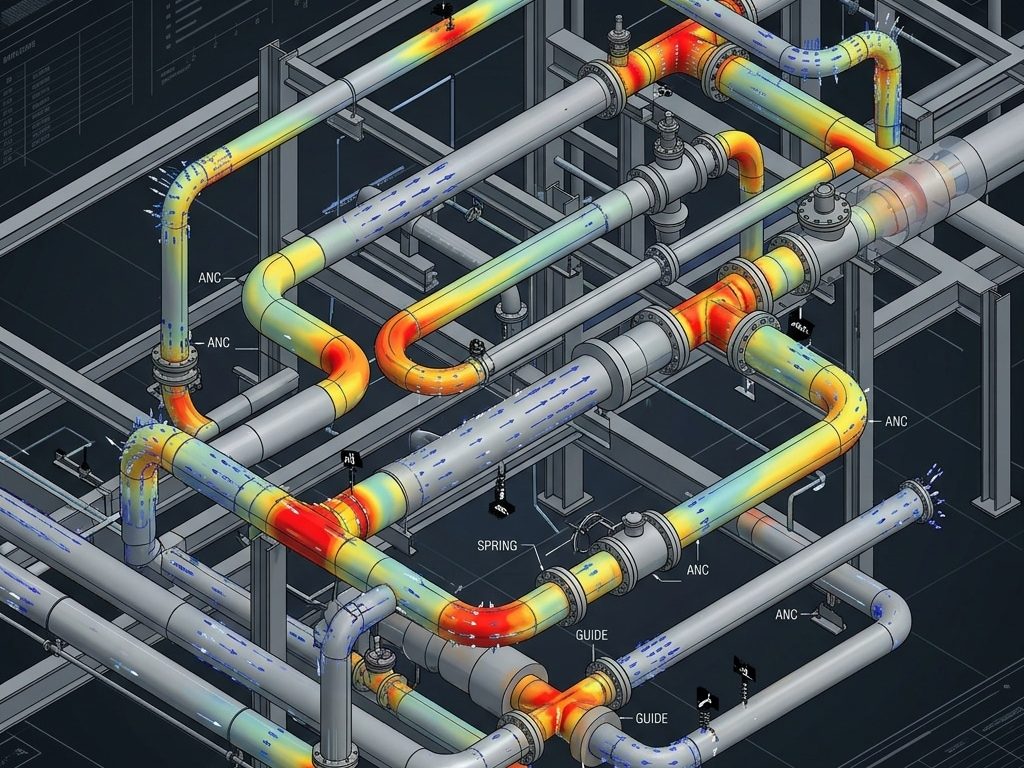
CAESAR II (developed by Hexagon PPM) is the global industry standard for static and dynamic piping stress analysis. It models the complete three-dimensional behavior of a piping system under deadweight, internal pressure, thermal expansion, wind, seismic, and dynamic loads — calculating the resulting stresses, displacements, and equipment nozzle loads against the allowable limits defined in international codes such as ASME B31.1, B31.3, and B31.4.
CAESAR II does not just check whether pipes are strong enough — it evaluates the entire mechanical relationship between the pipe, its supports, and the vessels it connects to. The nozzle loads it produces feed directly into our PV Elite and Nozzle Pro assessments, closing the design loop between piping and static equipment engineering.
Core Load Cases CAESAR II Evaluates
Every CAESAR II model must be solved for multiple load case combinations, as required by ASME B31 codes. Our engineers configure these systematically for every stress-critical line.
- Sustained Loads (SUS): Dead weight of pipe, fluid, and insulation combined with internal pressure — the baseline structural loading condition.
- Thermal Expansion (EXP): Stresses induced by temperature-driven elongation and contraction of the pipe between its anchored endpoints.
- Occasional Loads (OCC): Wind forces, seismic accelerations, and pressure surges applied per the facility’s site hazard classification.
- Operating Combinations: Combined loading scenarios (e.g., SUS + EXP + OCC) to capture the worst-case real operating conditions.
- Nozzle Load Extraction: Forces and moments at every equipment connection point exported for WRC-107 or Nozzle Pro FEA vessel assessment.
CAESAR II Compliance: Key ASME B31 Code Differences
| ASME Code | Application | Typical Industries |
|---|---|---|
| ASME B31.1 | Power piping — steam, water, and gas in power generation | Power plants, utilities, district heating |
| ASME B31.3 | Process piping — general industrial chemical & hydrocarbon service | Oil & gas, petrochemical, chemical plants |
| ASME B31.4 | Liquid transportation pipeline systems | Oil pipelines, terminal facilities |
| ASME B31.8 | Gas transmission and distribution piping | Natural gas pipelines, gas distribution |
Engineering Warning: Applying the wrong ASME B31 code edition to a piping system is a critical engineering error. The allowable stress values, load combination rules, and flexibility factor methods differ significantly between codes — using B31.1 allowables for a B31.3 process system can either under-design or over-conservatively reject a perfectly safe configuration.
How CAESAR II Connects to the Full Engineering Chain
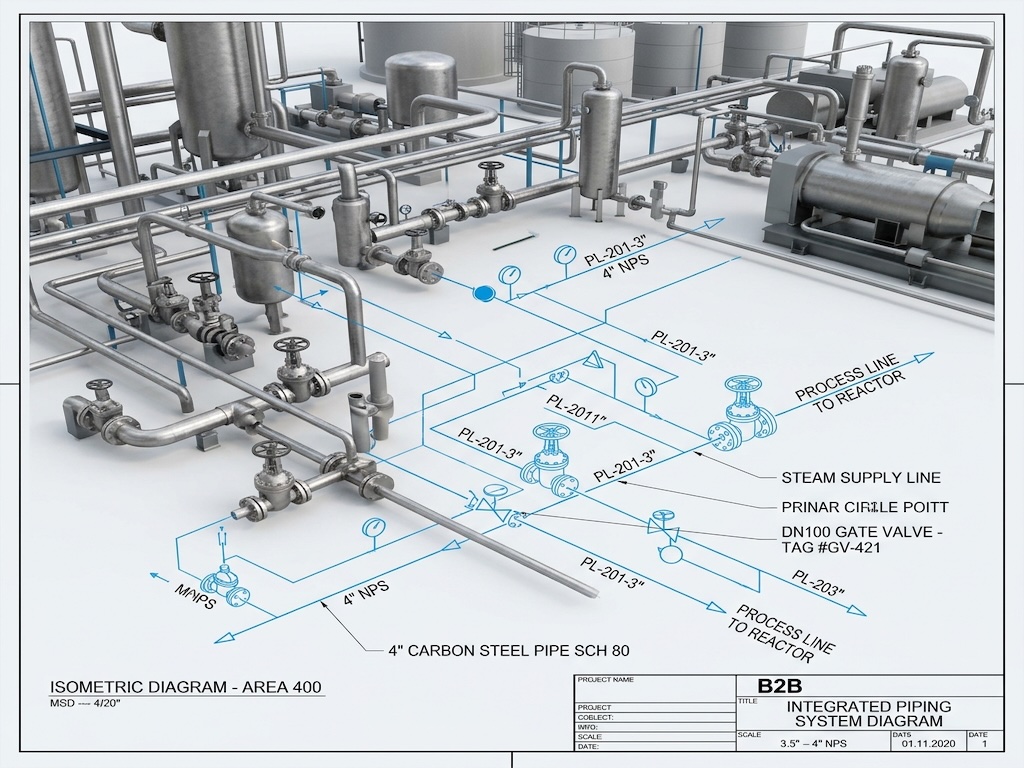
CAESAR II does not operate in isolation — it is the mechanical bridge that connects AutoCAD Plant 3D routing geometry to the static equipment nozzle design requirements.
- Pipe geometry imported from AutoCAD Plant 3D — PCF file import populates the pipe centreline, all fittings, and support positions directly into the CAESAR II model.
- Operating parameters applied — design temperature, pressure, fluid density, and insulation weight entered for each pipe segment.
- Support types defined — anchors, guides, line stops, and spring hangers modeled with stiffnesses that reflect the real physical supports planned in the 3D model.
- Load cases solved — ASME B31 code stress ratios calculated for every node across all required load combinations.
- Over-stressed sections identified and resolved — supports repositioned, loops added, or pipe spec upgraded to bring all stress ratios below 1.0.
- Nozzle loads reported — final nozzle forces and moments documented and issued to the vessel engineering team for WRC or Nozzle Pro assessment.
Frequently Asked Questions
-
What is CAESAR II used for?
CAESAR II is used to evaluate whether a piping system is structurally safe under all operating conditions. It calculates thermal expansion stresses, deadweight stresses, and equipment nozzle loads — checking them against ASME B31 code allowable limits to ensure the system will not fail in operation.
-
What is thermal expansion in piping?
Thermal expansion is the dimensional growth of a metal pipe as its temperature increases. A 100-meter carbon steel line at 350°C elongates by approximately 40 cm compared to its cold state. If this expansion is not absorbed by bends, loops, or expansion joints, it generates enormous forces that can rupture the pipe or destroy connected equipment.
-
What are allowable nozzle loads?
Allowable nozzle loads are the maximum forces and moments that a pressure vessel nozzle can withstand from the connected piping without experiencing localized failure. CAESAR II calculates the actual imposed loads, which are then checked against manufacturer-stated or code-calculated allowables using tools like WRC-107 or Nozzle Pro FEA.
-
What is a spring hanger in piping?
A spring hanger is a pipe support device that uses a calibrated coil spring to allow controlled vertical pipe movement during thermal expansion while still carrying the pipe’s deadweight. CAESAR II is used to calculate the exact hot and cold spring loads required to keep equipment nozzle forces within allowable limits.
Keep Your Piping Safe and Your Equipment Intact
An unchecked pipe stress problem discovered during commissioning costs magnitudes more to fix than one resolved at the design stage using CAESAR II. Our piping engineering team delivers complete ASME B31-compliant stress analysis packages — with full nozzle load reports, support specifications, and engineer-stamped compliance documentation. Explore our full piping design and stress analysis capabilities to understand our complete delivery scope.